Paytia Lets AI Agents Take Card Payments — Without the Card Ever Reaching the AI
15 July 2026
New Capture Assist API keeps card and personal data out of the model's context window, call recordings and chat logs, closing the PCI gap that comes with AI agents.
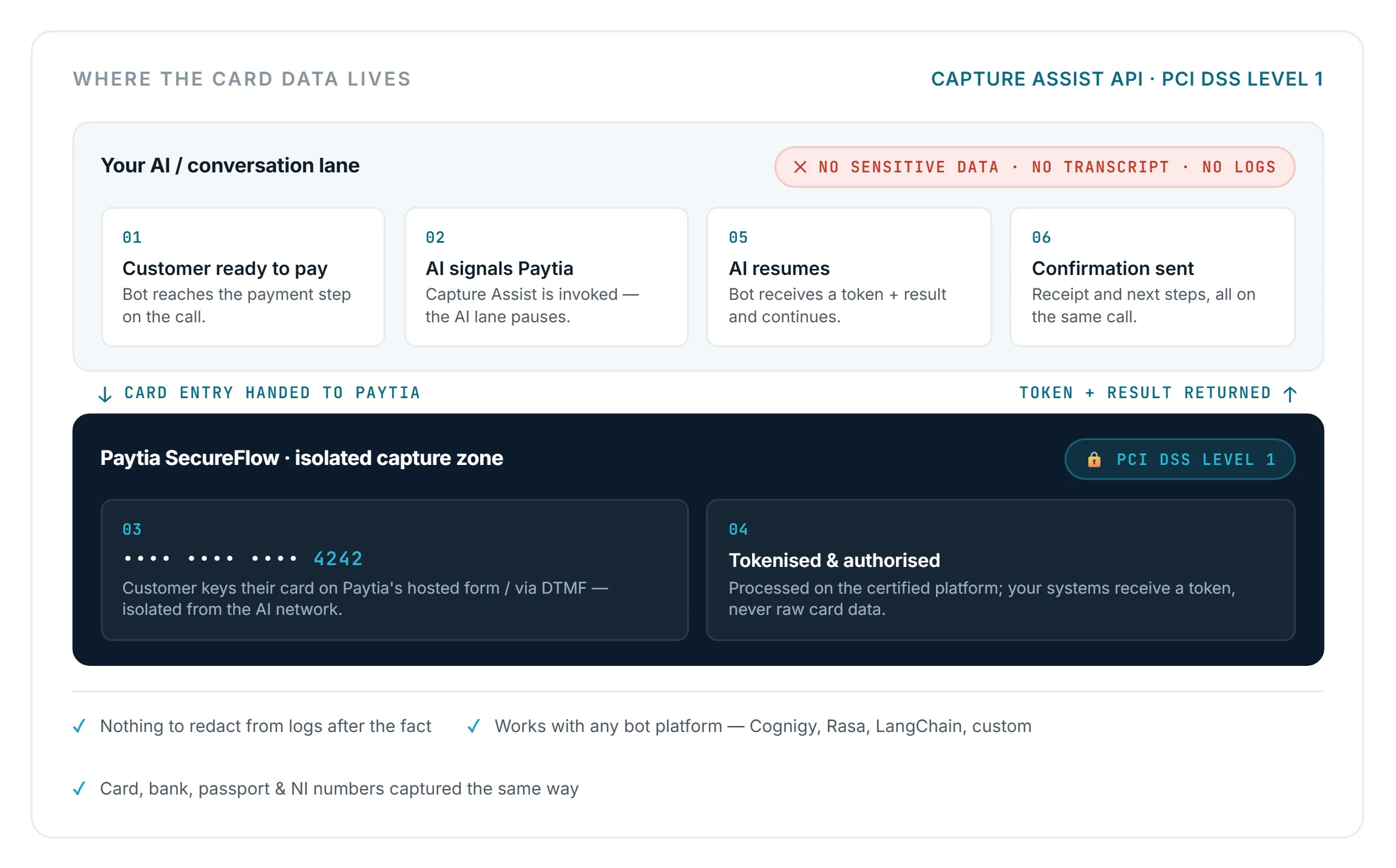
LONDON, UNITED KINGDOM, 15 July 2026 — Businesses are putting AI agents on the phone and in chat faster than their compliance teams can keep up. The problem shows up the moment one of those agents has to take a payment: the card number passes straight through the language model's context window, and it can leak into call recordings, chat logs and training data. That's a PCI DSS nightmare, and it's happening quietly inside a lot of new AI deployments.
Paytia today launched Conversational & AI Payments, built on its Capture Assist API, to close that gap. The service takes a bank or card payment inside an AI agent's conversation — by phone or chat — while keeping the sensitive data entirely outside the AI's network, transcript and logs.
When the agent reaches the payment step, it calls Capture Assist. The customer enters their card on Paytia's hosted form, or by keypad on a call, fully isolated from the AI. Paytia processes it on its PCI DSS Level 1 SecureFlow platform, returns a token and a result, and the bot picks the conversation straight back up. No transfer, no “check your email”, no raw card data anywhere near the model.
“If there's an AI in the loop, this is the only safe way to take a payment. A card number should never sit in a chat log or an LLM's context — but that's exactly where it ends up in most of the AI agents being built right now. We draw a hard line around the card. The bot runs the conversation, we hold the sensitive data, and the two never mix.”
— Curtis Nash, CEO, Paytia
It isn't only cards. The same isolation model covers bank account details, passport numbers and national insurance numbers — any sensitive data the process needs to capture.
For telephone agents, Paytia connects over SIP in one of two ways: sitting in front of the bot for total isolation, or conferencing in on demand when a payment is due, with a unique call ID in the SIP header triggering capture. Chat agents capture through Advanced Payment Links. It works alongside the platforms teams are already building on, and for anyone already using Paytia, turning it on is a config change rather than a new contract.
The service is backed by a Data Protection Agreement. Paytia acts as the appointed data processor with defined terms for how sensitive data is captured, retained and deleted. Card data is never logged or used to train models. Paytia holds PCI DSS Level 1 and Cyber Essentials Plus certification and has processed more than £400 million since 2020.
Conversational & AI Payments is available now. Book a demo.
About Paytia
Paytia provides PCI-compliant secure payment services that let businesses take card and bank payments over the phone, online and now inside AI conversations, without sensitive data entering their own systems. Paytia serves clients across the UK, US and Canada from offices in London and New York.
Media contact
Sidney Reeves · sidney.reeves@paytia.com · +44 20 7183 3536 (London) · +1 315 716 2226 (New York)
Coverage: Finextra.
More News
Paytia Launches a Free Card Rate Check
22 September 2026
Paytia Puts All Nine PCI Self-Assessment Questionnaires in Your Pocket
24 July 2026
Paytia Named Most Innovative Secure Payment Technology Provider 2025
31 May 2026
Paytia Listed as a Stripe Partner
6 August 2019
Paytia Available on the Adobe Commerce Marketplace
15 April 2026
Paytia Announces Technology Partnership with Aircall
12 September 2024