

Merchant payment processing is the combined work of accepting, authorising, settling, and reconciling electronic payments made to a business. Most explainers stop at the four-party model and call it a day. That's the technical flow — useful, but it doesn't answer the question businesses actually have when they look at their monthly statement: which fee comes from which party, and which ones can be negotiated. This guide covers both — what happens when a card is tapped, and where every penny in the fee stack actually goes.
What is merchant payment processing?#
Merchant payment processing covers everything that has to happen between a customer presenting a card (or entering its details, or tapping a phone) and the resulting funds landing in the business's bank account. It includes the real-time authorisation check, the daily capture and submission, the routing across the card networks, and the back-office reconciliation that ties each settled amount to the original sale.
The traditional model is described as four parties: the cardholder, the merchant, the acquirer (the merchant's bank), and the issuer (the cardholder's bank). That's accurate but incomplete in 2026. A fifth party — the gateway or processor — sits between the merchant and the acquirer for almost every business today. The gateway handles the technical connection, tokenisation, fraud screening, and the API the merchant's website or terminal talks to. The acquirer handles the regulated banking side: holding the merchant account, taking on liability, and moving funds. Sometimes the gateway and acquirer are the same company; often they're not, and the merchant pays both.
If you're new to the terminology, our glossary entries on the payment gateway, the acquiring bank, and the broader payment service provider role cover each in more detail.
How a single card payment actually flows#
The trip from "tap" to "settled funds in your bank account" looks instant from the customer's side. From the merchant's side, it's five distinct stages that happen across two timescales — seconds for the first two, days for the rest.
The first stage is the authorisation request. The terminal or checkout sends the card details to the gateway. The gateway forwards them to the acquirer, which routes them through the card network (Visa, Mastercard, Amex) to the issuing bank. The issuer checks the card is valid, the cardholder has the funds or credit available, and the transaction doesn't trip any fraud rules.
The second stage is the authorisation response. The issuer sends an approve or decline back through the same chain. The terminal beeps, the screen says "Approved," and the customer walks away. Start to finish, that takes around two seconds.
The third stage is capture. The merchant flags the authorised transaction for settlement. For most businesses this is automatic and batched at the end of each day — the terminal or gateway submits the day's authorised transactions in a single batch. Until capture happens, the funds are reserved on the cardholder's account but haven't actually moved.
The fourth stage is clearing. The acquirer submits the captured batch to the card network, which routes each transaction to the relevant issuer. The issuers confirm the amounts owed.
The fifth stage is settlement. The issuers transfer funds to the acquirer through the network. The acquirer credits the merchant's account, minus the fees, usually one to three working days after capture. Some acquirers offer next-day or same-day settlement on premium plans; some take longer for higher-risk accounts.
The reason the whole cycle takes one to three days, despite the auth taking two seconds, is that clearing and settlement still run on batch processes inherited from the pre-internet era. Faster Payments and open banking rails settle in seconds, but card networks haven't followed yet — which is part of why alternative payment methods are growing.

Want to see this working in your setup? Book a working-demo call — we'll wire up your actual phone system and show you a live capture.
Who takes a cut and how much#
The fee stack is the bit most businesses care about, and it's the bit most providers explain badly. Here's a worked example on a £100 transaction paid by a UK consumer debit card in a card-present shop.
Interchange is the largest single component and goes to the issuing bank. It's set by Visa or Mastercard, not by the acquirer, which means the acquirer can't negotiate it down — only pass it through. On a UK consumer debit card, regulation caps interchange at 0.2%, so the issuer gets around £0.20. On a UK consumer credit card the cap is 0.3% — about £0.30. On a corporate card or a card issued outside the UK or EEA, there's no cap and interchange can run from 1.5% to over 2.5%, which is why a business with a heavily corporate customer base sees a higher effective rate than the headline suggests.
Scheme fees go to Visa or Mastercard for use of their network. These are smaller — typically 0.05% to 0.20% — but they've crept up steadily over the last few years and some acquirers pass increases through automatically.
Acquirer markup is the acquirer's margin on top. This is the negotiable bit. A high-volume merchant on interchange-plus pricing might pay 0.1% to 0.2%; a small business on blended pricing might pay 0.5% or more without realising it, because it's bundled into a single quoted rate.
Gateway fees are charged by whoever provides the technical connection — sometimes the same company as the acquirer, often not. A typical structure is a monthly subscription (£15 to £50) plus a per-transaction fee of 5p to 20p. The per-transaction part is where heavy-volume merchants get hit hardest, because it's a flat amount regardless of transaction size.
Add it up: on that £100 consumer debit card, the merchant typically pays £0.40 to £1.05 on interchange-plus pricing, or 1.4%–1.8% headline on blended pricing in total fees — between 1.4% and 1.8%. On the same transaction with a corporate card or an international card, it might be 2.8% to 3.5%. That spread is why effective rate and headline rate so rarely match. For a deeper breakdown of the fee layers, we've written a separate piece on merchant services fees.
The Merchant Category Code (MCC)#
One thing most explainers skip is that every merchant gets assigned a Merchant Category Code at onboarding — a four-digit code that classifies what the business sells. The MCC determines which interchange band applies, how the card networks treat fraud risk, how rewards programs award points to the cardholder, and how likely the transaction is to be flagged for review or disputed.
The MCC is supposed to be set correctly at onboarding, but in practice it's often wrong. A common error: a tech consultancy gets classified as 7372 (computer programming and data processing services) when the work is actually closer to 5734 (computer software stores) — and the two MCCs carry different interchange rates and different fraud profiles. A florist set up as 5814 (eating places and restaurants) instead of 5992 (florists) will see odd patterns of declines on cards that have restaurant-spending restrictions.
If your effective rate is higher than it should be, or you're seeing declines that don't make sense, ask your acquirer to confirm your MCC and check it against the official ISO 18245 list. Changing an MCC is usually a simple form, but the acquirer won't do it proactively. Our glossary entry on the merchant category code covers the detail.
Card-present vs card-not-present vs phone payments#
Three transaction flows, three risk classes, three fee bands. The headline difference is whether the card is physically present at the point of payment.
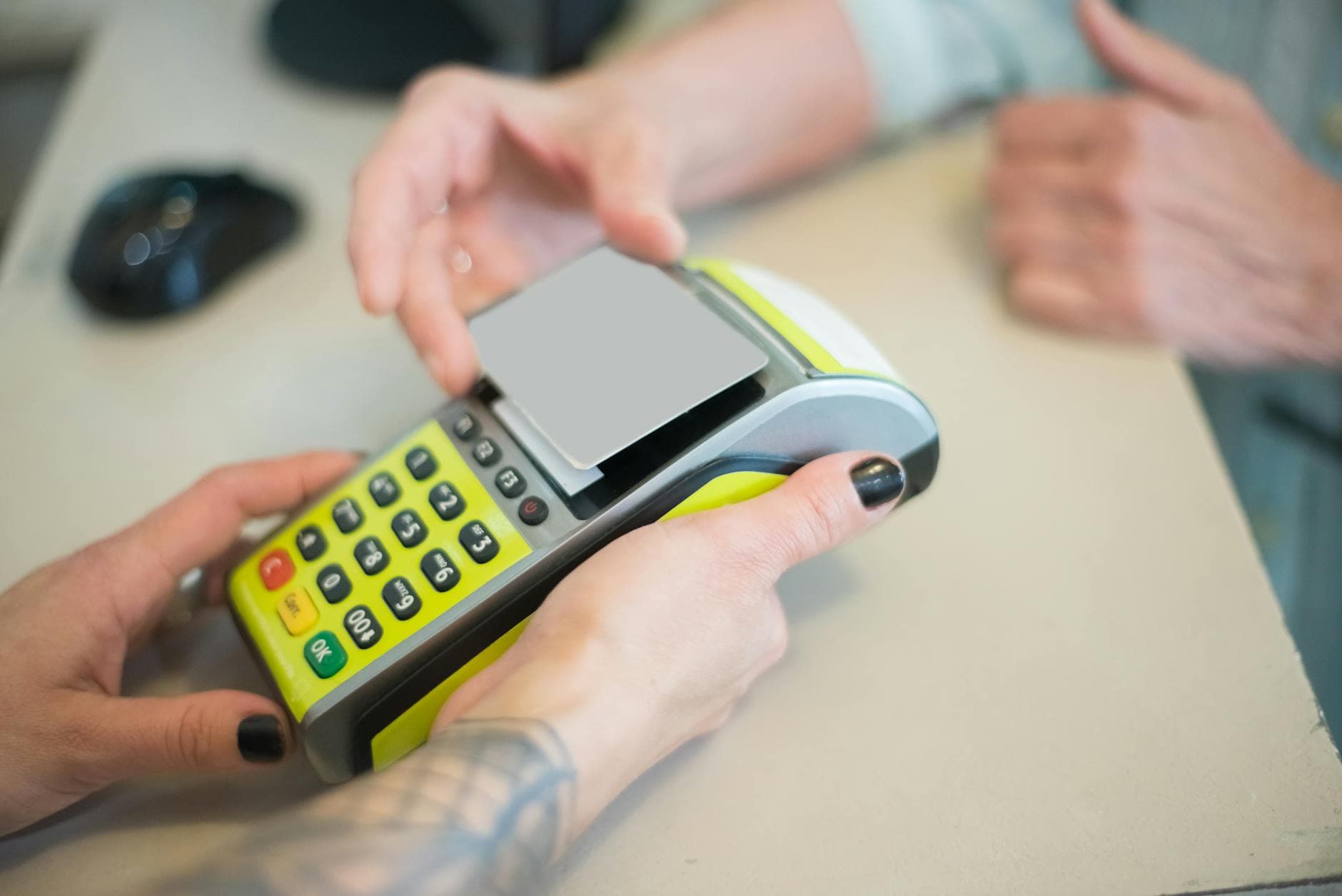
Card-present covers chip-and-PIN, contactless, and mobile wallet taps at a physical terminal. It carries the lowest interchange because the card and cardholder are both verified in person — the fraud risk to the issuer is lowest. A typical card-present consumer debit transaction in the UK sits around 1.4% to 1.6% all-in. Our glossary entry on card-present transactions covers the technical detail.
Card-not-present covers everything where the card isn't physically dipped or tapped — ecommerce, phone orders, mail orders, recurring billing. Interchange is higher because the issuer can't verify the cardholder is physically present. Effective rates of 1.8% to 2.5% are normal. The card-not-present guide goes into the fraud and compliance trade-offs in more depth.
Phone payments are technically a sub-type of card-not-present, but they're worth singling out because they carry the highest chargeback rate of any channel — somewhere around materially higher — frequently several times the ecommerce rate, depending on industry. The reason is straightforward: a customer reading their card number out loud over the phone leaves a verbal trail rather than a digital one. If the merchant later disputes a chargeback, there's no equivalent of the customer's IP address, browser fingerprint, or 3D Secure authentication record to point to as proof of consent.
That's where DTMF masking comes in. Instead of the customer reading their card number aloud, they key it into their phone's keypad during the call. The DTMF tones are intercepted and replaced with flat tones before they reach the agent or any recording. The agent never hears the card details. The card data goes directly from the customer's phone to the payment processor — the merchant's systems never see it. We cover the technical flow on the DTMF masking page, and the broader case for using it in any phone-payment scenario on the phone payments solution page. Beyond cutting chargebacks, DTMF masking pulls the merchant's phone system out of PCI DSS scope, which is the bigger commercial win for most businesses.
What to look for in a payment processor#
If you're shopping for a processor, or reviewing whether your current one is still right, there are five questions worth asking before signing anything. And when you reach the application stage, we've listed what banks need to assess your card processing application so you can get the paperwork ready early.
First, interchange-plus or blended pricing? Interchange-plus shows you the actual interchange on each transaction plus a fixed acquirer margin — transparent and usually cheaper for businesses with a predictable card mix. Blended bundles everything into a single rate — simpler to read but often more expensive, particularly if you process a mix of card types. Small businesses are usually quoted blended by default; ask for interchange-plus and see what happens.
Second, settlement speed. Standard is one to three working days after capture. Some processors offer next-day or same-day settlement, sometimes for a fee, sometimes free on certain plans. If your business has cashflow constraints around payment timing, this matters more than the headline rate.
Third, chargeback handling. Every processor charges an admin fee per chargeback — £15 to £25 is typical, regardless of whether you win or lose. Some also charge a "representment" fee if you contest the chargeback. Check both. If your sector has a high dispute rate, a £25 chargeback fee multiplied across hundreds of disputes a year adds up fast.
Fourth, integration approach. Some processors only work if you use their full stack — their gateway, their terminals, their reporting. Others are gateway-agnostic and slot into whatever you're already using. The locked-in approach is usually cheaper on paper; the agnostic approach is cheaper when you eventually need to change something.
Fifth, PCI scope impact. Different integration patterns put different amounts of your business inside PCI DSS scope. A redirect-to-hosted-checkout keeps you mostly out of scope. An iframe or direct API integration pulls more of your systems in. Phone payments without DTMF masking pull your entire telephony estate into scope. Each step further into scope means more audit work, more compliance cost, and more risk if something goes wrong.
Paytia is gateway-agnostic — we work alongside whichever acquirer and gateway you already use, rather than asking you to switch processors. That's the right shape for businesses that are happy with their existing card processing but need to fix the phone-payments piece without rebuilding everything else.
Frequently asked questions#
How much do payment processors charge?
For a typical UK small business on blended pricing, expect 1.4% to 2.9% per transaction depending on card type and channel, plus a monthly gateway fee of £15 to £50 and a per-transaction gateway fee of 5p to 20p. High-volume merchants on interchange-plus can get acquirer margins down to 0.1% to 0.3% but still pay interchange and scheme fees on top.
What's the difference between interchange-plus and blended pricing?
Interchange-plus shows you the actual interchange cost on each transaction plus a fixed acquirer margin — so a debit card costs less than a corporate card, and you can see exactly why. Blended quotes you a single rate that bundles everything together — simpler but usually more expensive, because the provider builds in margin to cover the worst-case card mix. For most businesses doing more than £10k a month, interchange-plus saves money once you've factored in the full card mix.
Can a small business get interchange-plus pricing?
Yes, but it's not the default offer. Most processors quote blended to small merchants because it's easier to sell. Ask explicitly for interchange-plus and have your last three months of statements ready to show your card mix. If the answer is no, that's a signal about how flexible the processor is on other things too.
Who pays the merchant fees on a refund?
The merchant. When you refund a customer, you don't get the original processing fee back — and on most acquirers you pay a small additional refund fee on top. This is one reason high-refund-rate businesses watch their effective rate creep up: every refund is paying fees twice.
What happens to fees on a chargeback?
You lose the original transaction fee, you pay a chargeback admin fee (typically £15 to £25), and if you contest the chargeback you may pay a representment fee whether you win or lose. If you lose the dispute, you also refund the full transaction amount. A single chargeback on a £100 sale can cost the merchant £140 or more by the time the dust settles.
Is the gateway the same as the processor?
Sometimes yes, often no. The gateway is the technical layer — the API your website or terminal talks to. The processor (acquirer) is the regulated banking layer that holds your merchant account and moves the funds. Some companies bundle both; others specialise in one and partner for the other. You can usually tell by looking at your monthly statement: if you see separate line items for "gateway fee" and "processing fee," they're separate providers.
Can a merchant change processors mid-contract?
Yes, but most merchant services contracts have a minimum term — 12 to 36 months is common — and charge an early termination fee if you leave early. The fee varies wildly: some are nominal, some are equivalent to several months of expected revenue. Always check the exit clause before signing, and if you're being pushed to sign a long-term deal, ask whether month-to-month is available even at a slightly higher rate. The flexibility is usually worth the markup.
Related reading#
- Pillar guide: Payment Gateway API Integration: 2026 Developer Guide
- Pay by Link vs Hosted Checkout: Which to Use
- Manual vs Automated Payment Chasing: When to Switch
- How Open Banking Works: Essential Business Guide
- What is click to pay: A Faster, Safer Online Checkout
Want to see this working in your setup? Book a working-demo call — we'll wire up your actual phone system and show you a live capture.