
A Practical Guide to IVR for Call Center Success
Get Secure Payment Solutions
Learn how Paytia can help secure your payment processing.
An Interactive Voice Response (IVR) for a call centre is an automated phone system that acts as the first point of contact, greeting callers, figuring out what they need, and getting them to the right person. But it’s much more than a simple menu. A modern IVR for call centre operations is like a digital concierge, capable of handling routine jobs like taking payments or checking account balances, which frees up your human agents for the trickier stuff.
Why Modern IVR Is Essential for Your Call Centre
Picture a chaotic airport terminal. There are no signs, no information screens, and no self-service kiosks. Travellers are just wandering around, forming long, messy queues, and getting more and more frustrated. That’s exactly what a call centre without a good IVR feels like to your customers. It's a place where every single question, no matter how simple, means waiting in line for a human.
A modern IVR brings order to that chaos. It's the airport's smart signage and self-service kiosks all rolled into one, guiding callers and letting them help themselves right away. This tech has come a long way from the endlessly looping, frustrating menus of the past. Today's systems are smart platforms that boost efficiency and genuinely improve the customer experience.
Bringing Order and Efficiency
At its heart, a well-designed IVR is there to sort and direct incoming calls before an agent ever has to. By asking a few straightforward questions, the system can understand why someone is calling and route them to the right department. Better yet, it can often solve their problem on the spot, with no human help needed at all.
This isn't just a nice-to-have; it's critical. Even with all the digital channels available, research shows 59% of UK customers still prefer picking up the phone to get an issue sorted. That preference puts a huge strain on call centres, where average call abandonment rates are creeping up to nearly 6%. The IVR is your first line of defence, filtering out the simple queries so that urgent calls get through faster.
An effective IVR doesn't just route calls; it resolves them. By enabling self-service for common tasks like bill payments, order tracking, or appointment scheduling, it deflects a significant volume of calls from the queue entirely.
Empowering Customers with Self-Service
People today expect instant answers and want to be in control. A powerful IVR meets this expectation head-on by offering self-service options 24/7. This turns your phone line into a resource that’s always available, letting customers get help long after your team has gone home for the day.
Key self-service functions an IVR can handle include:
- Secure Payments: Letting customers pay bills right over the phone using their keypad.
- Account Information: Giving them instant access to balances, due dates, or order updates.
- Information Retrieval: Answering frequently asked questions like business hours or office locations.
By providing these automated options, you’re not just cutting operational costs; you’re building trust and loyalty. To get a better feel for how these systems are put together, you can learn more about the fundamentals of a contact centre IVR. It’s all about turning a potential frustration into a smooth and satisfying experience.
The Evolution of IVR Capabilities at a Glance
To really appreciate the shift, it helps to see how IVR has evolved. What was once a basic, and often clunky, call-routing tool has become a sophisticated platform that actively enhances the customer journey.
| Feature | Traditional IVR Function | Modern IVR Capability |
|---|---|---|
| Input Method | Touch-tone (DTMF) only; "Press 1 for Sales..." | Conversational AI and Natural Language Processing (NLP) understand spoken requests and intent. |
| Routing Logic | Static, pre-defined call flows based on keypad input. | Dynamic, intelligent routing using CRM data, caller history, and real-time agent availability. |
| Self-Service | Limited to basic information retrieval (e.g., hours). | Comprehensive self-service for payments, appointment booking, order tracking, and account management. |
| Personalisation | Generic greetings for all callers. | Highly personalised interactions that greet callers by name and offer proactive, relevant options based on their data. |
| Integration | Standalone system with minimal external connections. | Deeply integrated with CRM, helpdesk, and payment systems to provide a seamless, omnichannel experience. |
| Analytics | Basic call volume and routing reports. | Advanced analytics on customer sentiment, journey mapping, and containment rates to drive continuous improvement. |
This table makes it clear: modern IVR is no longer just a gatekeeper. It's a proactive, intelligent part of your customer service strategy, designed to resolve issues quickly and efficiently.
How IVR Technology Actually Works
To get your head around how an IVR in a call centre works, picture a highly efficient digital receptionist. When a customer calls, they aren't just thrown into a noisy, confusing office. Instead, this automated receptionist greets them, quickly figures out what they need, and then either gives them the answer directly or connects them to the exact person who can help.
This whole process kicks off the second a call hits your telephony system, which is usually a Voice over IP (VoIP) network these days. The IVR's primary job is to understand what the caller wants and do something about it. In its most classic form, this all hinges on a surprisingly simple piece of tech.
The Foundation: DTMF Tones
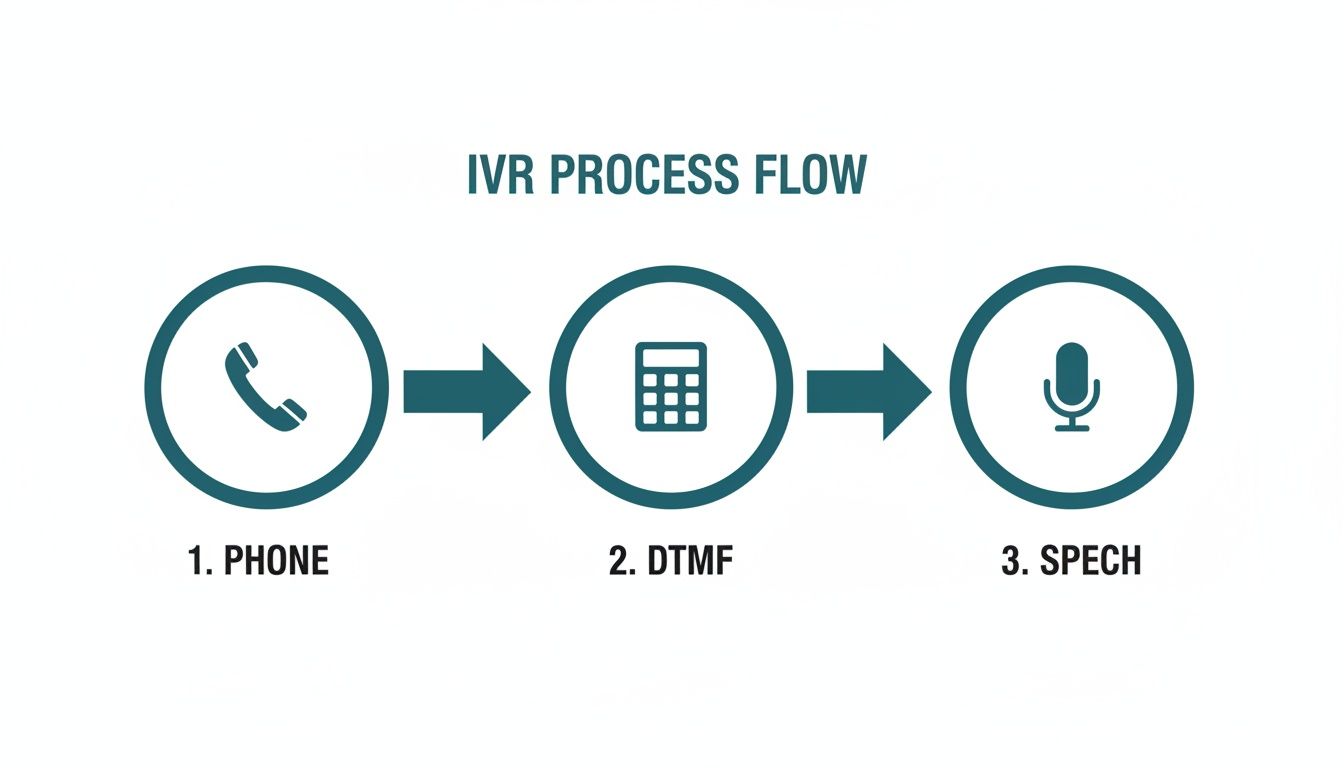
The bit of IVR we all know is Dual-Tone Multi-Frequency (DTMF) signalling. That’s just the technical name for the beeps your phone keypad makes. Every number has its own unique tone, and the IVR system is built to recognise these sounds instantly.
When a caller presses ‘1 for sales’ or ‘2 for support’, they’re sending a crystal-clear instruction. The IVR gets this DTMF input and follows a pre-written script, often called a ‘call flow’, to guide the customer to the next step. This could be playing another menu, offering some recorded info, or sending the call to a specific team.
It's also worth knowing how these signals are kept secure, especially during payments. Understanding concepts like DTMF masking shows how this basic technology is adapted to protect sensitive information from being exposed.
Adding a Voice with ASR and TTS
While DTMF is the reliable workhorse, modern IVR systems are a lot more conversational. They feel more natural to interact with, and that’s thanks to two key technologies working in tandem.
Automatic Speech Recognition (ASR): This is the system's ‘ears’. ASR tech takes the caller's spoken words and turns them into text the machine can understand. When an IVR asks, "How can I help you today?" and you reply, "I need to check my account balance," ASR is doing the hard work of deciphering your request.
Text-to-Speech (TTS): This is the IVR’s ‘voice’. TTS engines grab text-based data—like that account balance from your database—and convert it into a natural-sounding voice. This is what allows the system to give dynamic, personalised answers rather than just playing the same old pre-recorded clips.
Put them together, and ASR and TTS let a caller just say what they need in plain English, and the IVR can understand and respond just as a human would.
An IVR acts as a smart filter. By combining DTMF, ASR, and TTS, it can identify a caller's intent with remarkable accuracy, resolve common issues on its own, and ensure that when a call does reach an agent, it goes to the right person with the right skills.
Ultimately, a huge part of a modern IVR's job is just smart call routing. Thinking about optimizing call routing for faster service really gets to the heart of how this technology works in the real world. By sending callers where they need to go based on their keypad entries or spoken requests, the IVR cuts down handling times and makes for a much better customer experience. It’s not just about finding the right information; it’s about getting it to the customer as quickly as possible.
Securing Customer Payments with IVR Technology
Taking payments over the phone is a routine part of business, but it’s fraught with security risks. The moment a customer reads their card details out loud to an agent, that sensitive data enters your call centre environment. This immediately puts a heavy compliance burden on your shoulders and opens the door to costly data breaches.
This is where a secure IVR for call centre payments comes in, acting as a protective shield that isolates sensitive information from your agents and internal systems altogether.
A massive part of this is understanding and sticking to industry standards like PCI DSS compliance. Think of the Payment Card Industry Data Security Standard (PCI DSS) as the rulebook for handling credit card payments. It’s a rigorous set of controls to ensure any company that processes, stores, or transmits card data maintains a secure environment. Getting this wrong can lead to eye-watering fines and a complete breakdown of customer trust.
How IVR Shields Sensitive Payment Data
A secure payment IVR essentially creates a sterile, isolated channel for the customer to enter their card details. It’s like building a secure 'payment tunnel' that completely bypasses your agent and your call centre's infrastructure. While the agent stays on the line to help the customer, they never actually see, hear, or handle the card numbers. This is all made possible by some clever, specialised technologies.
The process hinges on the IVR’s ability to interpret customer inputs, whether they’re pressing keys on their phone or speaking their responses.
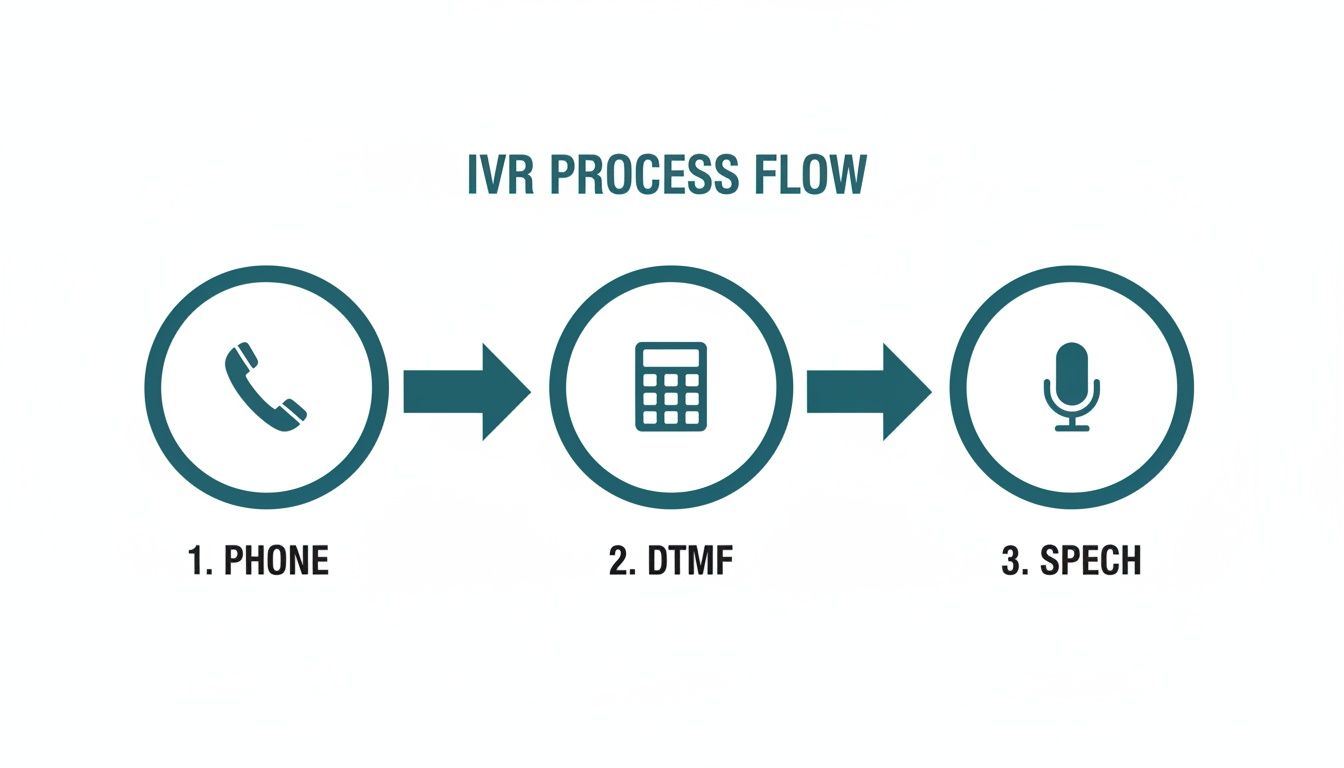
This flow is the foundation, but two core technologies are the real magic behind securing the payment leg of the journey:
DTMF Suppression: This is a bit like putting digital earmuffs on your agent and the call recording software. When the customer punches in their card number, the DTMF tones are 'muffled' or masked. Your agent just hears a flat, unrecognisable sound, and the call recording captures nothing but silence. The actual data is sent directly to the payment processor, never once touching your systems.
Tokenization: Imagine your customer’s credit card number is a priceless diamond. Instead of passing the diamond around, tokenization swaps it for a single-use, numbered ticket. This 'token' stands in for the card details but is completely worthless to a thief. If someone intercepted it, they couldn't use it for fraudulent purchases. It's a simple but incredibly powerful layer of security.
By taking your agents and infrastructure completely out of the payment data flow, these technologies can slash your PCI DSS scope by as much as 95%. This doesn't just tighten security—it dramatically cuts the cost and complexity of staying compliant.
The Practical Impact on Your Call Centre
Putting a secure IVR payment system in place changes everything. It eliminates the risk of agents scribbling card details on sticky notes or keying them into unsecured spreadsheets. Right away, you’re protected from both external hackers and the potential for internal fraud.
This approach also builds a huge amount of trust. Customers are more savvy than ever about data security and they notice when a business takes concrete steps to protect them. Using an automated, secure system shows you're serious about their privacy, which is a fantastic way to build loyalty.
If you want to get into the nuts and bolts of how this works, our guide on the IVR payment flow provides a much deeper dive: https://www.paytia.com/ivr-payment-flow-guide
Ultimately, this isn't just a technical upgrade; it's a fundamental improvement to both your customer experience and your entire security posture.
The Real Business Benefits of Implementing an IVR
While the technical specs of a modern IVR for call centre operations are impressive, their true worth is measured by the tangible impact they have on your business. Implementing an effective IVR isn't just a tech upgrade; it's a strategic move that pays dividends in efficiency, customer experience, and your bottom line.
Think of it as a force multiplier for your support team. A good IVR takes on the repetitive, high-volume queries, freeing up your skilled agents to handle the nuanced interactions that actually require a human touch—empathy, complex problem-solving, and relationship-building. This shift fundamentally changes how your call centre operates for the better.
Driving Unprecedented Operational Efficiency
The first and most immediate win you'll see from a well-designed IVR is a massive jump in efficiency. It acts as an intelligent front door, filtering and resolving the routine enquiries that would otherwise jam your phone lines and eat up precious agent time. This process, known as call deflection, is the secret to managing high call volumes without constantly having to hire more staff.
When customers can sort out simple issues themselves—like checking an order status or confirming an appointment—they never even enter the queue. This frees up your agents to focus on the calls that really matter, leading to shorter wait times and fewer frustrated callers hanging up.
A North American financial institution discovered its IVR system was successfully handling 50% of its total annual call volume. This level of automation transforms agents from simple information dispensers into expert problem solvers.
This isn't just theory. Imagine a utility company that automates half of its billing enquiries. That saved time is instantly reinvested into handling more urgent customer issues, boosting service quality across the board without adding a single person to the payroll.
Elevating the Customer Experience
There’s a common myth that customers hate IVRs. The truth is, customers hate bad IVRs. A modern, smartly designed system actually improves the customer experience by giving people fast, easy answers.
When built correctly, an IVR for call centre success delivers:
- 24/7 Availability: Customers can get help or complete tasks like making a payment whenever it suits them, day or night. This isn't a luxury anymore; it's what people expect.
- Instant Resolutions: For simple questions, self-service is always faster than waiting to speak to a person. That immediacy creates a feeling of empowerment and boosts satisfaction.
- Intelligent Routing: When a caller does need to speak to an agent, the IVR makes sure they land in the right place the first time. By gathering a bit of information upfront, it connects them to the department or agent best equipped to solve their specific problem.
All of this creates a smoother, more personal journey. For example, an IVR connected to your CRM can greet a returning customer by name and offer menu options based on their recent orders. It’s a small touch, but it shows you know who they are and builds real loyalty. It's no surprise that one study found a modern IVR can improve caller satisfaction by 10–25%.
Delivering Significant Cost Reductions
Ultimately, all these operational gains and customer experience improvements translate directly into major cost savings. The maths is simple: when automation handles a bigger slice of your call volume, your cost-per-interaction drops dramatically.
The financial benefits show up in a few key areas. First, by cutting down the number of calls that need an agent, you lower staffing costs and reduce the need for overtime during busy periods. Automation lets you do more with the team you already have.
Second, shorter call handling times make your existing agents more productive, which further trims your operational overhead. The market growth in the UK reflects this clear value proposition. In the United Kingdom, the Interactive Voice Response market for call centres recently hit approximately USD 33 million, with steady growth expected as more businesses catch on. You can read more about the regional market trends and growth.
By automating tasks, speeding up resolutions, and allocating your people more effectively, a modern IVR becomes one of the most powerful tools for optimising your call centre budget and driving long-term profitability.
Your Step-by-Step IVR Implementation Roadmap
Successfully launching an IVR for call centre operations isn't about just plugging in a new bit of tech. You need a clear, strategic plan to make sure the system actually helps your business and your customers. A rushed job leads to confusing menus and frustrated callers, completely defeating the purpose.
This roadmap breaks the whole thing down into manageable phases. Follow it, and you'll sidestep the common pitfalls and build an IVR that’s a genuine asset, not just another source of irritation.
Phase 1: Strategic Planning and Goal Setting
Before you even think about looking at vendors, you need to define what success looks like. What problems are you actually trying to solve? Setting clear, measurable goals from the get-go is the single most important step.
Start by mapping out your most common customer journeys. Why are people calling you? Are they checking order statuses, paying bills, or looking for tech support? This quick analysis will point you straight to the high-volume, repetitive tasks that are perfect candidates for automation.
Your goals need to be specific and tangible:
- Reduce call handling time by an average of 30 seconds within six months.
- Increase the call containment rate (the percentage of calls fully handled by the IVR) to 40%.
- Improve First Contact Resolution (FCR) by routing calls to the right agent, first time.
With solid objectives like these, you have a benchmark to measure your return on investment. It'll guide every single decision you make from here on out.
Phase 2: Vendor Selection and Technical Integration
Once your goals are crystal clear, it’s time to start sizing up potential partners. The right vendor is more than just a software provider; they're a long-term partner in your customer service strategy. Look for specialists with proven experience in your industry and rock-solid security credentials, especially if you plan on taking payments.
Technical integration is where the rubber meets the road. Your IVR has to talk fluently with your existing tech, especially your Customer Relationship Management (CRM) system and your telephony platform (VoIP/PBX). A deep CRM integration lets the IVR personalise the experience – think greeting a caller by name or offering options based on their recent orders.
A seamless integration is non-negotiable. The ability to pull data from your CRM in real-time and pass call context to an agent is what separates a basic IVR from a truly intelligent customer service tool.
Also, think about integration with your payment gateway if you want to automate payments. A solution like Paytia is built for this, offering pre-built connections that can slash your time-to-value by taking the pain out of complex PCI DSS compliance.
Phase 3: Customer-Centric Design and Testing
This is where you build the experience your callers will actually interact with. The key here is simple: think like your customer. Ditch the long, complicated menus and robotic, jargon-filled voice prompts.
Stick to these design best practices:
- Keep Menus Short and Simple: No more than four or five options per menu. If you need more, use a sub-menu.
- Write Clear, Concise Prompts: Use natural, everyday language. And please, tell callers which number to press after you describe the option.
- Always Offer an Escape Hatch: Make sure there's an obvious and easy way to speak to a human at every single stage.
Before you flick the switch, you need to test, test, and test again. Create test cases for every possible scenario and call path. Get people from outside the project team to call in and give honest feedback. This user acceptance testing (UAT) is your secret weapon for finding confusing prompts or broken pathways your internal team might miss, ensuring a smooth, flawless launch day for your customers.
Choosing the Right IVR Vendor for Your Call Centre
Picking an IVR for call centre operations isn't just another software purchase – it's a strategic partnership. The performance, security, and future-readiness of your entire system hinge on the vendor you choose. You’ve got to look past the glossy sales pitch and focus on the foundational capabilities that will actually support your business for the long haul.
A vendor’s technology is just one piece of the puzzle. You need a partner who genuinely understands the unique demands of your industry, whether that's the tight compliance world of finance or the empathetic touch required in healthcare. Their expertise needs to go beyond the product itself to include rock-solid support and a clear vision for where their platform is heading.
Core Evaluation Criteria
When you start comparing potential IVR providers, a structured evaluation helps you cut through the marketing noise. It’s best to focus your assessment on a few non-negotiable pillars that determine the system's real value and reliability. These are the things that will make or break your customer experience and operational efficiency.
Start by examining their security credentials with a critical eye. In an age where data breaches are a constant threat, robust security isn't just a feature—it's the very bedrock of customer trust.
Any vendor that will handle payments must have PCI DSS Level 1 certification. This is the highest level of validation available, proving their infrastructure is regularly audited and secure. Settling for anything less exposes your business and your customers to completely unnecessary risk.
Beyond security, you absolutely must confirm that the vendor's platform can slot in seamlessly with your existing tech stack. An IVR that operates in a silo is a relic of the past. Modern systems have to communicate flawlessly with your CRM, telephony platform, and other core business tools to deliver a truly connected and personal customer journey.
A Practical Vendor Comparison Checklist
To help you organise your thoughts, use this checklist to compare potential partners side-by-side. This structured approach makes sure you cover all the critical areas before you sign on the dotted line.
Here’s a simple table to help you keep track of what really matters when evaluating potential IVR partners.
IVR Vendor Evaluation Checklist
| Evaluation Criterion | What to Look For | Why It Matters |
|---|---|---|
| Security & Compliance | PCI DSS Level 1 certification, GDPR alignment, and evidence of regular security audits. | Protects sensitive customer data, reduces your compliance burden, and builds lasting trust with your callers. |
| Integration Capabilities | Pre-built connectors for your CRM (e.g., Salesforce, HubSpot) and open APIs for custom development. | Enables personalised customer interactions, provides agents with crucial context, and creates a unified view of the customer. |
| Scalability & Reliability | Proven ability to handle high call volumes, clear uptime guarantees (99.9% or higher), and geographically redundant data centres. | Ensures your system remains stable during unexpected traffic spikes and seasonal peaks, preventing dropped calls and customer frustration. |
| Industry Experience | Case studies, testimonials, and existing clients within your specific sector (e.g., retail, finance, healthcare). | Demonstrates an understanding of your unique challenges, compliance needs, and the specific self-service functions your customers value most. |
| Support & Partnership | Clearly defined Service Level Agreements (SLAs), access to UK-based technical experts, and dedicated implementation support. | Guarantees you have responsive, expert help when you need it most, from initial setup to ongoing optimisation and troubleshooting. |
Choosing the right vendor is a foundational step. By prioritising security, integration, and proven reliability, you can select a partner that not only provides a powerful IVR for your call centre but also helps you smash your wider business objectives.
Still Have Questions About IVR?
Even after seeing the benefits laid out, it’s natural to have a few practical questions about putting an IVR system to work in your own call centre. Getting these details right is what builds confidence and paves the way for a smooth, successful rollout. Let's tackle some of the most common queries we hear from decision-makers.
The good news? Modern systems are a world away from the rigid, complex technology of the past. Today’s IVRs are built for flexibility and ease of use, putting control right back into the hands of the people who manage the customer experience every day.
How Hard Is It to Update an IVR Menu?
Honestly, updating a modern, cloud-based IVR is surprisingly simple. Gone are the days of needing to call in a developer for every minor tweak. Most systems today come with an intuitive web portal where your own team can adjust call flows, swap out audio prompts, or change routing rules with just a few clicks.
This agility means you can react instantly to what your business needs. Whether you're updating your opening hours for a bank holiday, launching a new marketing campaign, or redirecting calls during an unexpected service outage, you can make the changes yourself in minutes, not weeks.
Can an IVR Talk to Our Existing CRM?
Yes, and this is where an IVR truly shows its power. Deep integration with your CRM is a defining feature of any modern IVR worth its salt. This connection allows the system to pull customer data in real-time and deliver a genuinely personalised experience.
Imagine it greeting callers by name or offering menu options based on their recent order history. Better yet, if a call does need to be handed over, the IVR passes all the caller's details and their journey so far directly to the agent's screen. This completely eliminates the dreaded, "Can you give me your account number again?" and creates a seamless, far less frustrating journey for everyone.
The goal of an IVR isn't to replace your human agents. It's to handle routine tasks with maximum efficiency, freeing up your team for the complex conversations where empathy and expertise truly matter.
Will My Customers Actually Want to Use It?
Whether a customer loves or hates your IVR comes down to one thing: its design. Clunky, confusing IVRs from a decade ago rightfully earned a bad reputation. But a well-designed modern system is all about giving customers a shortcut. When it helps them solve an issue instantly without waiting in a queue, they often prefer it.
Think about it from their perspective. If someone can pay a bill or check a delivery status in 60 seconds using the keypad versus waiting five minutes to speak to a person, they’ll almost always choose the faster option. It puts them in control and saves valuable time—a clear win for customer satisfaction.
Ready to transform your customer experience with a secure, efficient IVR solution? Discover how Paytia can streamline your call centre operations and protect every payment. Learn more about our platform at https://www.paytia.com.
Ready to Get Started?
Contact Paytia to learn how we can help secure your payment processing.