Quick summary
Tokenisation swaps a real card number for a meaningless placeholder, so the sensitive data never lives on your servers. That single architectural decision removes most of your PCI DSS v4.0.1 obligations, makes a breach far less damaging, and lets you take recurring payments without ever touching the original PAN again.
Last updated: 29 May 2026
US reader? See the US version of this guide with US-specific compliance detail (TCPA, NYDFS, CCPA, FedNow, US PCI scope guidance).
Tokenisation means swapping a real, sensitive value — like a 16-digit card number — for a stand-in token that looks similar but has no value outside the system that issued it. Someone who steals the token can't reverse-engineer the original card number. That's the whole point: it's a way of storing a reference to a payment card without storing anything an attacker can actually use.
In practice, this matters most in two situations. First, if you take recurring payments and need to charge the same card again later — you store the token, not the PAN. Second, if you're reducing your PCI DSS scope: a system that only ever touches tokens is largely out of scope, because there's no sensitive cardholder data to protect.
For UK organisations, tokenisation has stopped being a nice-to-have and become a basic requirement. PCI DSS v4.0.1 (the version in force since June 2024, after the March 2025 transition deadline passed) hardens the rules around how cardholder data is stored, processed and transmitted. The cheapest way to meet those rules is to stop holding the data in the first place. That's what tokenisation does.
A Simple Analogy For Tokenisation#
Think of it like checking a valuable coat at a fancy restaurant. You hand over your coat, and in return, you get a small, numbered ticket. This ticket is your key to getting the coat back, but it means nothing to anyone else. If a thief stole that ticket, they wouldn't get your expensive coat — they'd just have a useless piece of paper. The coat itself stays locked away in a secure cloakroom, accessible only to staff who can match your ticket to it.
This is exactly how tokenisation protects financial data. The credit card number is the valuable coat, and the token is the cloakroom ticket.
When you make a purchase, your actual payment details aren't stored by the business you're paying. Instead, they're sent to a highly secure, centralised system known as a token vault — this is the restaurant's secure cloakroom. The vault safely stores your sensitive data and generates a unique, non-sensitive token, which it then sends back to the business for their records.
This token can then be used for things like recurring payments, refunds, or even for analytics, all without ever re-exposing your real card number. The business only ever interacts with the "ticket," while your actual Primary Account Number (PAN) — the "coat" — stays locked away and protected inside the vault. You can learn more about what a PAN is and why it's so critical to protect in our detailed guide.
What Makes a Token So Secure?
This whole process changes the type of data a business has to manage. They go from handling high-risk, sensitive information to managing low-risk tokens, which has huge implications for their security and compliance obligations.
- Irreversibility — You can't mathematically reverse-engineer a token to figure out the original data. Unlike encrypted data, there's no "key" that can unlock it. The only controlled path back to the PAN is a vault-side lookup — see our breakdown of how detokenization actually works.
- Uniqueness — Every token is a randomly generated string of numbers and letters, completely unique to a specific piece of data for a specific merchant.
- Format Preservation — Tokens can be designed to mimic the format of the original data (like a 16-digit number that looks like a credit card). That lets you keep using older, legacy systems without expensive software rewrites.
Sensitive Data vs Token At a Glance
Let's break down the key differences between the original sensitive data and its tokenised stand-in. The table below gives a quick snapshot of why this swap is so effective.
| Characteristic | Original Payment Data (PAN) | Token |
|---|---|---|
| Value | High intrinsic value to fraudsters. | No exploitable value on its own. |
| Security Risk | High. If stolen, can be used for fraud. | Very low. Useless to attackers. |
| PCI DSS Scope | In-scope. Requires strict security controls. | Out-of-scope. Reduces compliance burden. |
| Reversibility | N/A (It's the original data) | Cannot be mathematically reversed. |
| Use Case | Authorising initial transactions. | Recurring payments, refunds, analytics. |
| Storage | Heavily restricted and must be encrypted. | Can be stored in standard systems. |
As you can see, the token retains the practical usefulness of the original data for business operations but sheds all of the associated risk.
By swapping sensitive data for a token, an organisation effectively removes the value from the data it holds. A data breach becomes far less catastrophic because attackers would only steal the equivalent of cloakroom tickets, not the valuable assets themselves.
How The Tokenisation Process Actually Works#
To really get why tokenisation is such a major improvement for security, you have to look under the bonnet. The cloakroom analogy is great for the big picture, but the real value is in the technical steps that make the whole system so reliable for any business handling sensitive data.
The journey from a customer's raw credit card number to a secure token is a carefully choreographed sequence between your business, a payment gateway, and a secure token vault. Every single step is designed to make sure the original, high-risk data never even touches your internal systems.
Think of it like this: the valuable "coat" (the card number) is swapped for a simple "ticket" (the token), and the coat itself is locked away in a high-security "vault".
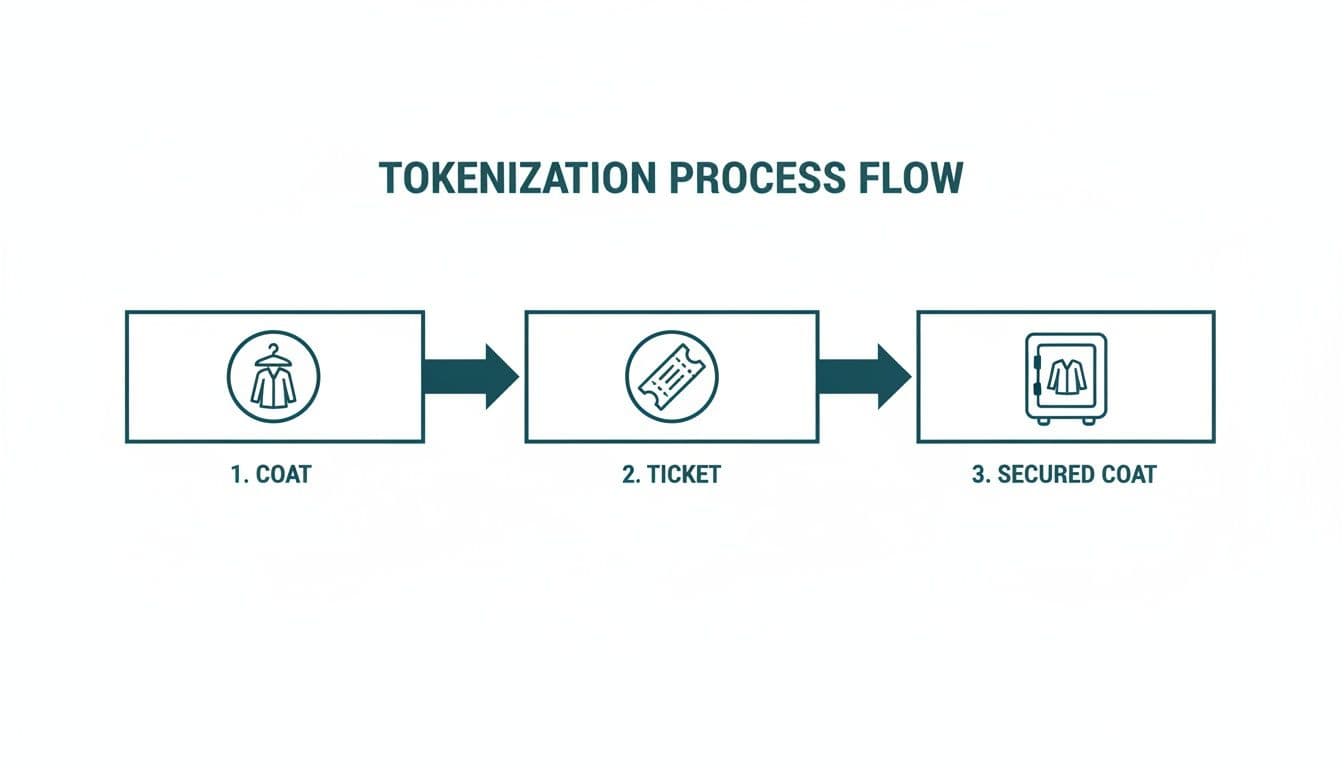
This simple swap is the core of the process. You're replacing something a fraudster would love to get their hands on with a useless placeholder.
The Step-By-Step Tokenisation Workflow
Let's walk through what happens during a typical payment, whether it's online, in an app, or a customer paying over the phone in your contact centre. The flow is remarkably consistent.
Data Capture — The customer gives you their payment details — the 16-digit Primary Account Number (PAN), expiry date, and CVC. This happens at the point of interaction, maybe through an encrypted web form or a secure phone payment system where the agent never sees or hears the numbers.
Secure Transmission — This is the important part. The sensitive data is immediately sent directly to the tokenisation provider or payment gateway. It completely bypasses your own servers and applications, which is the single biggest move you can make to slash your PCI DSS compliance scope.
Token Generation — The gateway receives the raw card number. In an instant, it generates a unique, non-sensitive token. At the same time, it locks the original PAN and its new token partner away in a highly protected, isolated environment called a token vault.
A token vault isn't just any database. It's a purpose-built digital fortress, designed solely for storing sensitive data. These vaults are certified to the highest level of PCI DSS compliance, with strong encryption, ultra-strict access controls, and 24/7 monitoring.
Token Return — The brand-new token is sent back to your system. Now this is something you can safely store. You can link it to a customer's record in your CRM or billing platform without taking on serious security risks.
Transaction Processing — For that first payment, the gateway uses the original PAN it just received to get the transaction authorised by the bank. Once approved, the sale is complete.
Future Use — Here's the long-term win. For any future payments, like a recurring subscription or a refund, you just send the token to the gateway. The gateway looks it up in the vault, finds the real card number, and processes the new transaction. Your business never has to touch the raw PAN again.
Understanding Different Token Types
Not all tokens are built the same. The right one for you often depends on your existing software and how you operate. There are two main flavours you'll come across.
Random Alphanumeric Tokens — These are jumbled strings of letters and numbers that look nothing like the original card number. They offer fantastic security, but they can sometimes cause headaches for older, legacy systems that are hard-coded to expect a number in a specific format.
Format-Preserving Tokens (FPTs) — These are a bit more sophisticated. An FPT is designed to mimic the format of the original data. For instance, a token for a 16-digit Visa card will also be a 16-digit number that starts with a '4' and passes basic format checks. This is a lifesaver for businesses with older systems, as it lets them adopt tokenisation without a painful and expensive software overhaul.
Network Tokens vs PSP Tokens — A Quick Note
One other distinction worth pinning down: tokens issued by the card networks (Visa, Mastercard, Amex) are different from tokens issued by your payment service provider. Network tokens are portable across PSPs and update automatically when a card is reissued — useful for subscription businesses where card churn kills recurring revenue. PSP tokens live inside one provider's vault and don't travel if you switch processors. We've written a full breakdown in our guide on network tokens vs PSP tokens. For most UK businesses, the answer is "use both" — the PSP token for the immediate transaction, the network token for the long-lived credential on file.
Once you see the workflow, it's clear how tokenisation acts as a powerful shield. It isolates the information that criminals want, letting you run your business efficiently without the constant risk and regulatory burden of storing raw payment data.
Curious how Paytia fits in? Have a quick chat with us — we'll show you in 15 minutes whether we're a fit.
Tokenisation vs Encryption: What's the Difference?#
People often talk about tokenization vs encryption in the same breath, but they're different ways to secure data. Getting them confused is easy to do, but it can leave serious gaps in your security. Both are designed to protect sensitive information, but how they do it and what they protect are worlds apart.
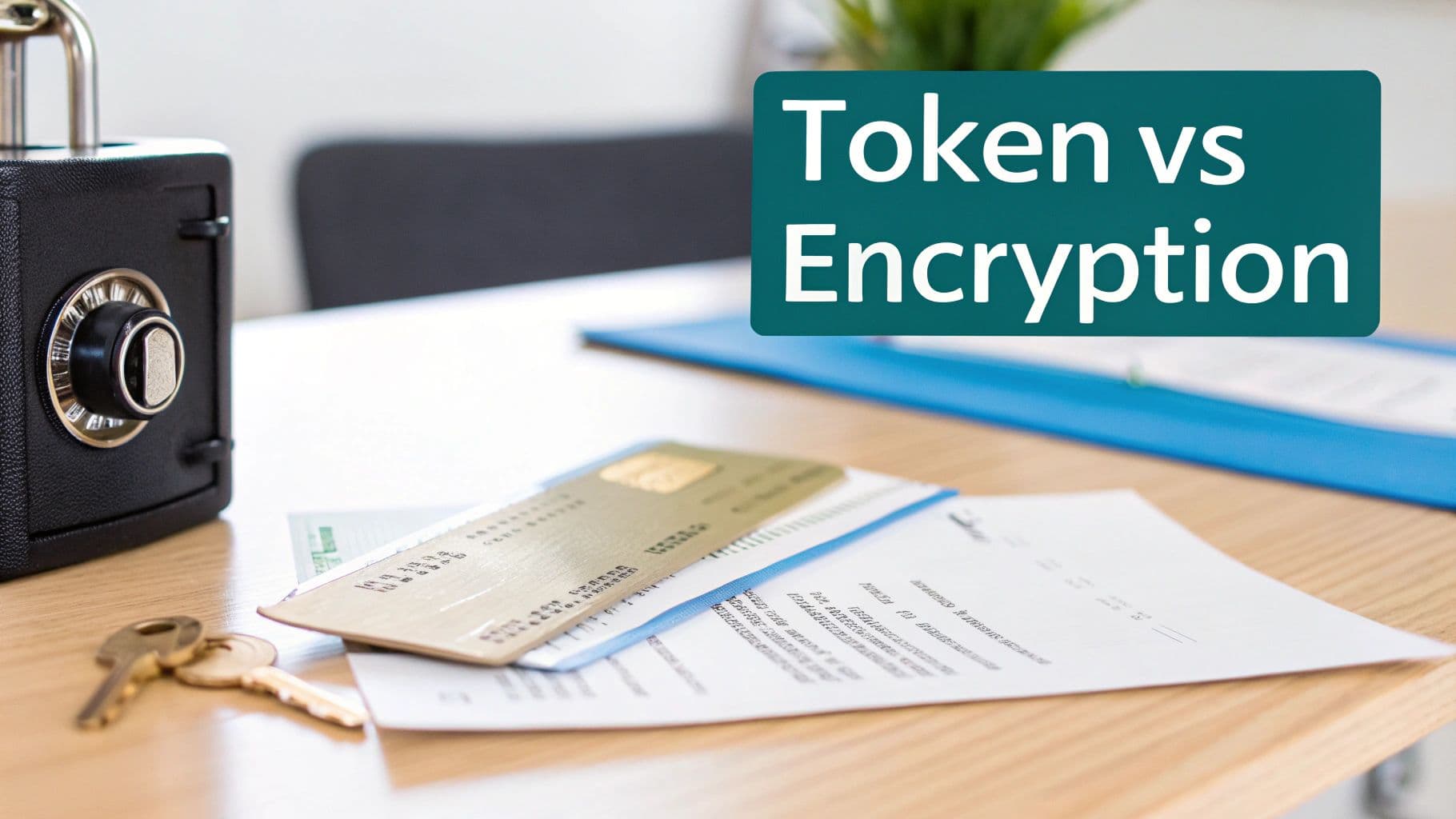
Think of encryption as locking your valuables in a high-tech safe. The original data is still there, but it's scrambled into an unreadable mess called ciphertext. To get it back, you need the right encryption key. The problem? If a thief gets hold of both the safe (the encrypted data) and the key, they can unlock it and see everything.
Tokenisation works more like exchanging your valuables for a claim ticket. The original, sensitive data is completely removed from your systems and locked away in a secure, isolated vault. What you get back is a token — a placeholder that has no mathematical relationship to the original data. It's impossible to reverse-engineer the token to figure out the original details.
The Core Mechanical Distinction
The fundamental difference comes down to what happens to the data and how it's protected.
- Encryption is a mathematical exercise. It uses a complex algorithm and a secret key to change your data. The entire security of the system hangs on keeping that key safe.
- Tokenisation is all about substitution. It yanks the sensitive data out of your environment entirely, swapping it for a non-sensitive stand-in. Its security comes from this complete removal.
Encryption modifies the data you hold, making it unreadable without a key. Tokenisation removes the data you hold, replacing it with something that has no value to attackers. The risk is not just reduced; it is relocated away from your business.
This distinction is massive when it comes to compliance. Encrypted data is still technically in your possession, meaning it remains within the scope of regulations like PCI DSS. But because tokenisation removes the asset from your environment, your compliance burden shrinks dramatically.
When To Use Each Method
Neither approach is better than the other; they're built for different jobs. In fact, they often work best together as part of a layered security strategy. Understanding these differences is a core part of building a solid Data Loss Prevention (DLP) plan.
You'd use Encryption for —
- Data in Transit — When information is moving across a network (like a customer submitting a form on your website), encryption (TLS/SSL) is essential to stop anyone from snooping on the connection. For card-present and contact-centre captures specifically, the in-transit equivalent is point-to-point encryption (P2PE) — a Council-validated standard that pairs neatly with tokenisation downstream.
- Data at Rest — This is for securing large databases or file archives that you might need to decrypt later for analysis. It keeps the stored data safe from unauthorised access.
You'd use Tokenisation for —
- Payment Processing — This is its bread and butter. By tokenising card numbers, you can process payments, handle refunds, and manage subscriptions without ever letting sensitive cardholder data touch your systems.
- Protecting PII — It's perfect for securing personally identifiable information like national insurance or driving licence numbers in your internal systems where you don't need the original value for day-to-day work.
Comparing Tokenisation and Encryption
Let's put them side-by-side to make the differences clear. This table breaks down how these two security tools function.
| Feature | Tokenisation | Encryption |
|---|---|---|
| Core Process | Substitutes sensitive data with a non-sensitive token. | Scrambles data into an unreadable format (ciphertext). |
| Data Location | Original data is removed and stored in a secure vault. | Original data remains, just in a modified, unreadable state. |
| Reversibility | Not mathematically reversible; requires vault access. | Reversible with the correct decryption key. |
| Data Format | Can preserve the format of the original data (FPT). | Results in a random-looking string of characters. |
| PCI DSS Impact | Drastically reduces compliance scope. | Data remains in-scope, requiring strict key management. |
| Primary Use | Securing payment card data and PII in business systems. | Securing data in transit and at rest. |
In the end, it's not about choosing one over the other. A solid security posture uses both. You'll use encryption to protect data on its way to the token vault, and then tokenisation takes over to make sure the sensitive parts are removed from your environment for good.
The Business Case For Adopting Tokenisation#
While the technical side of tokenisation is impressive, the real question for any business leader is simple: what does this actually do for my bottom line? The truth is, adopting tokenisation isn't just a security upgrade. It's a strategic business decision that delivers tangible financial and operational wins by completely changing how you manage risk.
The single biggest advantage is a dramatic reduction in your Payment Card Industry Data Security Standard (PCI DSS) compliance scope. When sensitive cardholder data never enters or rests within your systems, you effectively 'de-scope' those parts of your business from many of the standard's toughest — and most expensive — requirements. That's a complete shift, not a marginal one.
This de-scoping translates directly into cost savings. You'll deal with less complex and less frequent audits, spend less on specialised security infrastructure, and free up your IT and compliance teams from soul-crushing admin. Instead of managing a high-risk data environment, they can get back to focusing on what actually grows the business.
Slashing Compliance Costs and Complexity
For many businesses, the primary driver for adopting tokenisation is the sheer relief it provides from PCI DSS obligations. As long as raw card data is present in your environment — even if it's encrypted — you're on the hook for protecting it under a strict and unforgiving set of rules. Tokenisation removes the data, and with it, much of the responsibility. That's the practical difference between tokenization and encryption when you're sat in front of a QSA — encryption protects what you still hold; tokenisation stops you holding it.
Here's how it immediately impacts your operations:
- Reduced Audit Scope — Auditors can certify that your systems are out of scope, which massively simplifies the assessment process and lowers the associated costs. For many UK SMEs, this is the difference between needing a full Report on Compliance (RoC) and being able to file a Self-Assessment Questionnaire (SAQ) A — the smallest, cheapest SAQ.
- Lowered Risk of Penalties — A data breach is incredibly costly, with fines for non-compliance running into tens of thousands of pounds per month. The ICO can also issue GDPR penalties of up to 4% of global annual turnover or £17.5 million, whichever is higher, when personal data is exposed. By minimising the data you hold, you minimise this huge financial risk.
- Simplified Operations — Your teams no longer need to wrestle with complex encryption key rotations or tightly restricted databases for payment information. Your entire IT infrastructure becomes simpler and easier to manage.
By removing the very asset that criminals are after — the actual card number — you drastically lower your profile as a target. Tokenisation isn't just about passing an audit; it's about making your business less attractive to attackers, which is the ultimate form of risk management.
These requirements can be tricky to get right, so it pays to understand the specifics. You can see how this works in practice by exploring a deeper look at how Paytia helps with PCI DSS compliance.
PCI DSS v4.0.1 — What Tokenisation Specifically Changes
The current standard, PCI DSS v4.0.1, has been the only valid version since v3.2.1 was retired. Several of its newer requirements are particularly painful to meet if you still hold raw card data — and largely disappear if you don't.
- Requirement 3.5.1 mandates that PAN be unreadable wherever it's stored. If you've tokenised, you have no PAN to make unreadable. The requirement still technically applies, but there's nothing left in scope for it to bite.
- Requirement 8.3.6 increases minimum password length for systems in the cardholder data environment (CDE). A smaller CDE means fewer systems to harden, fewer accounts to manage, fewer audit findings.
- Requirement 11.6.1 (new in v4) requires change-detection mechanisms on payment pages to catch e-skimming. If your payment page is hosted by your PSP and you only receive a token back, this requirement is satisfied by the provider, not by you.
- Requirement 12.3.1 demands a targeted risk analysis for any custom security controls. Fewer in-scope systems = fewer custom controls = less risk-analysis paperwork.
None of this means PCI DSS goes away. You're still responsible for the systems that handle tokens, and you'll still file an SAQ. But the volume of work drops sharply when the most regulated data simply isn't there anymore.
Building Customer Trust and Enabling Growth
Data breach headlines are a near-daily occurrence, and customer trust has become an incredibly valuable currency. When customers know you're taking advanced steps to protect their information, their confidence in your brand grows. This is especially true in places like contact centres, where payments are often taken over the phone.
Tokenisation gives you a powerful story to tell about security. You can confidently state that your agents never see, hear, or handle sensitive card details, and that this data is never stored on your systems. That kind of assurance can boost conversion rates and build real, long-term loyalty.
This strong security foundation also unlocks safer omnichannel experiences. A token generated from a phone payment can be safely used for a future online purchase, or vice versa. You get a secure customer journey across every sales channel without ever re-exposing sensitive data.
The UK tokenisation market has seen incredible growth, reflecting this rising demand for secure payment tech. The market was valued at around USD 284.1 million and is projected to hit USD 929.0 million by 2030, growing at a blistering 22.5% annually. That trend shows just how vital the technology has become for UK businesses.
Of course, tokenisation protects live data, but a complete security strategy considers the entire data lifecycle. Understanding solid practices for secure data destruction is important for properly disposing of old hardware that might contain residual information. Ultimately, tokenisation is an investment in resilience, trust, and efficiency — providing a clear and compelling business case.
What UK Buyers Actually Save — A Rough Sketch
We don't publish customer names, but the savings pattern is consistent across the housing associations, insurance brokers and contact centres we work with. A mid-sized UK contact centre that previously held card data in its CRM, call recordings and CSV exports typically saw:
- QSA audit time drop from 4–6 weeks of preparation to 1–2 weeks once the agent-facing systems no longer touched PAN.
- Call-recording redaction tooling — previously a five-figure annual licence — became unnecessary, because nothing sensitive was in the recording in the first place.
- The shift from SAQ D to SAQ A reduced the number of in-scope controls by roughly an order of magnitude (SAQ D has hundreds of requirements; SAQ A has around two dozen).
- Cyber insurance premiums dropped at next renewal once the underwriter understood the CDE had shrunk to "essentially nothing".
These aren't unique outcomes — they're the predictable result of removing the data, not securing it harder.
How To Implement Tokenisation In Your Business#
Understanding the power of tokenisation is one thing; actually bringing it into your organisation is another. The good news is that implementing this technology has never been more accessible. For most, the journey starts with a simple question: should you build your own solution or partner with a specialist?
Each path has its trade-offs. Building an in-house tokenisation system gives you ultimate control, but it's a monumental undertaking. This route demands deep expertise in cryptography and data security, a substantial upfront investment in infrastructure, and ongoing resources to manage maintenance, updates, and the all-important PCI DSS Level 1 certification.
For the vast majority of businesses, partnering with a dedicated tokenisation provider is the far more practical and secure choice. These providers have already poured millions into building and certifying their platforms, so you can tap into business-grade security without the enormous cost and operational headache. It's a faster, safer way to get to market while staying aligned with the latest security standards.
Choosing Your Implementation Path
When you team up with a third-party provider, the most common and flexible method of integration is through an Application Programming Interface (API). An API is the modern standard for connecting different software systems, letting your existing applications — like your CRM, billing software, or contact centre platform — talk directly and securely with the tokenisation service.
API-based tokenisation offers a way to weave security directly into your workflows without ripping out and replacing your current technology. For instance, when a customer gives you their payment details, your system makes a simple API call to the provider. The provider handles the token generation and vaulting, then sends the secure token back to your application for storage and future use.
This isn't just a trend; it's the dominant force in the market. Within the UK tokenisation landscape, API-based solutions represent the largest market segment, pulling in revenues of USD 148.86 million. More importantly, this approach is also the fastest-growing, projected to expand at an impressive rate of 26.33%. That rapid growth points to a clear preference for flexible, developer-friendly integrations that don't disrupt the business.
An API acts as a secure messenger between your systems and the token vault. It lets you request a token or use an existing one to process a payment, all without sensitive data ever touching your own infrastructure. That's the key to drastically reducing your PCI DSS compliance scope.
Key Integration Considerations
Successfully plugging a tokenisation solution into your business requires careful planning. It's not just about the tech, but how it fits into your unique processes, especially across different customer channels.
Before you start, think about the following:
- Existing Systems — Map out every application that currently handles or stores sensitive data. This includes your e-commerce platform, accounting software, and any customer management tools. An API solution needs to play nicely with this ecosystem.
- Customer Channels — How do you take payments? Your tokenisation strategy must cover every touchpoint — online, in-person, and especially over the phone in a contact centre. A single, unified token can create a secure and consistent omnichannel experience.
- Payment Gateway Compatibility — Check that the tokenisation provider works with your current payment gateway or offers a solution that meets your needs. Smooth integration here is vital for uninterrupted payment processing. Our guide on payment gateway API integration offers more insights into this critical relationship.
- Developer Resources — While APIs are designed to be straightforward, you'll still need some technical resources to manage the implementation. Look at the provider's documentation, support, and developer tools to make sure the rollout will be smooth.
Edge Cases UK Buyers Forget About
A few situations catch out UK businesses moving to tokenisation for the first time. They're worth thinking through before you sign anything.
- Refunds beyond the original token's lifetime. If a customer wants a refund 13 months after their original purchase and your token has expired, can you still process it? Ask the provider how long tokens live and whether refunds can be routed via the network token instead.
- Account updater. When a customer's card is reissued, the old PAN — and the PSP token derived from it — stops working. Network tokens update automatically; PSP tokens generally don't. For subscription businesses this matters enormously.
- Migration from a legacy system. You probably already hold thousands of card details in an older CRM or billing platform. Most reputable tokenisation providers offer a bulk vaulting service to tokenise existing records, but it has to happen under PCI-compliant conditions. Don't email a CSV of PANs anywhere — ever.
- Voice biometrics and AI-driven IVRs. If you're rolling out conversational AI in your contact centre, make sure the payment moment is fully tokenised. Recordings of an LLM-led conversation that includes spoken card numbers are catastrophic from a PCI scope perspective.
- Failure modes. What happens if the token vault is unreachable? Good providers have multi-region failover; cheaper ones don't. Ask for the SLA and the historical uptime figures, not just the brochure.
How Different UK Sectors Use Tokenisation
The shape of a tokenisation rollout depends heavily on the sector. A few patterns we see consistently:
- Housing associations tokenise to take rent payments by phone without their housing officers handling card data. The agents talk the resident through the payment, the resident keys in their card via DTMF capture, and the housing association's CRM only stores a token tied to the tenancy record.
- Insurance brokers use tokenisation for renewal billing. The token lives in the policy admin system and is reused at each renewal. When a customer reports a new card, the broker collects the new details once via a secure capture flow and the new token replaces the old one — no PAN ever lands in the broker's database.
- Contact centres across utilities, telecoms and retail use tokenisation primarily to clean PAN out of call recordings. Once the agent triggers the secure capture, the audio is paused or muted while the customer keys in card details, and the recording resumes once the token comes back.
- Foreign-exchange bureaux tokenise to support card-on-file flows for repeat customers transferring money internationally, often combined with strong customer authentication under the FCA's Strong Customer Authentication rules.
- Charities use tokenisation to store donor card details for recurring giving — particularly important where Gift Aid declarations require the donor to be linked to a verifiable identity, but the card number itself doesn't need to live in the charity's CRM.
By carefully considering these factors and choosing a flexible, API-driven partner, you can roll out a tokenisation project that secures your data, slashes your compliance burden, and builds lasting trust with your customers.
Answering Your Questions About Tokenisation#
As you start to explore what tokenisation could mean for your business, it's only natural to have a few questions. This technology changes how you handle sensitive data, so getting clear on the details is a must. To help you move forward with confidence, we've put together answers to some of the most common questions we hear from decision-makers.
Our goal here is to iron out any lingering uncertainties and reinforce the core concepts, giving you a solid picture of how this technology really works in the wild.
Can a Token Be Reversed to Get the Original Card Number?
This is one of the most important questions, and the answer gets right to the heart of why tokenisation is so secure. In short, no, a token cannot be mathematically reversed to reveal the original card number, or Primary Account Number (PAN). That's an important difference between tokenisation and its cousin, encryption.
With encryption, there's a direct mathematical link between the original data and the scrambled ciphertext. If an attacker somehow gets their hands on both the encrypted data and the decryption key, they can unlock it.
Tokenisation doesn't rely on a reversible formula. Instead, it's a system of pure substitution. The original card number is sent to an incredibly secure, isolated environment called a token vault. The vault then generates a completely random, unrelated token and sends that back to your system. The reverse process — how detokenization works inside the vault — is tightly controlled and audited so the merchant never sees the PAN again. The only connection between that token and the original PAN exists inside that heavily fortified vault, managed entirely by the tokenisation provider.
Think of it this way: there isn't a "key" that can unlock a token. To get the original data, an attacker would have to breach a PCI DSS Level 1 certified vault — one of the most secure digital fortresses on the planet. That makes the data you hold practically useless to them.
Is Tokenisation the Same as Full Encryption?
While they both protect data, they aren't the same thing. Tokenization and encryption are two distinct tools that solve different security challenges. As we touched on earlier, they work best when used together as part of a layered defence.
Here's a quick reminder of their different jobs:
- Encryption is like a temporary bodyguard for data on the move. It scrambles data while it's in transit (say, from a customer's browser to the payment gateway) and can protect it while it's at rest in a database. Crucially, though, the original data is still there — it's just in disguise.
- Tokenisation is about permanent removal. It takes the sensitive data completely out of your environment and swaps it for a secure placeholder. Your systems never have to store, process, or transmit the actual card number after that first transaction.
A solid security setup uses both. Encryption protects the card number on its initial journey to the token vault. Once it arrives safely, tokenisation takes over, removing that risky data from your systems for good.
How Does Tokenisation Secure Payments in a Contact Centre?
Contact centres are a perfect example of where tokenisation really shines — and where the architecture pairs naturally with P2PE-style transit controls to cut PCI scope at both ends of the call. Traditionally, agents taking payments over the phone created a massive security and compliance headache. They would hear or write down card numbers, and this sensitive audio could easily be captured in call recordings.
Tokenisation gets rid of these risks completely. When a customer is ready to pay, modern systems use one of two secure methods:
- DTMF Suppression — The customer types their card details using their telephone keypad. The agent stays on the line to help, but the tones (DTMF signals) are masked. The agent only hears flat beeps, and nothing sensitive is captured in the call recording.
- Secure Payment Links — The agent sends a payment link to the customer via SMS or email. The customer can then complete the transaction on their own device through a secure, tokenised portal.
In both cases, the sensitive card data goes directly from the customer to the payment processor, completely bypassing the agent and all your internal business systems. The contact centre only gets a token back confirming the payment was successful. That simple switch de-scopes the entire interaction from PCI DSS, protects agents from handling toxic data, and builds huge trust with customers.
What Is the First Step to Start Using Tokenisation?
Taking that first step can feel like the hardest part, but it doesn't have to be a huge ordeal. Your journey toward adopting tokenisation should kick off with a straightforward look at your current data environment and business processes.
Start by doing a quick internal audit. Map out every single touchpoint where your business currently interacts with sensitive payment data. Ask yourself:
- Where do we collect card details (website, over the phone, in-person)?
- Which systems store this information (our CRM, accounting software, random spreadsheets)?
- Who in our organisation actually has access to this data?
Once you have a clear map of your data flow, you can start looking into third-party tokenisation providers. Find a partner with a flexible API, proven experience in your industry, and a platform that can secure all your different payment channels. That initial assessment will give you the clarity you need to choose a solution that fits your unique operational needs and security goals.
Ready to secure your payments and simplify compliance? Paytia's SecureFlow platform uses advanced tokenisation to remove sensitive data from your business environment, protecting every transaction across phone, chat, and digital channels. Discover how you can reduce risk and build customer trust with Paytia.
Related reading#
- What Is a Tokenisation Vault? A Plain-English Guide
- Network Tokens vs PSP Tokens: What's the Difference?
- Tokenisation vs Encryption: What's the Difference?
- POS Tokenisation Explained: How Card Tokens Work at the Till
For the product side, see our Sensitive data capture solution.
Curious how Paytia fits in? Have a quick chat with us — we'll show you in 15 minutes whether we're a fit.
Related guides in this cluster#
Tokenization vs Encryption — Which to Use for Phone Payments
Encryption is reversible maths; tokenization is a lookup table. Here's where each one belongs in a PCI-compliant phone-payment stack — and why the combination cuts scope by up to 95%.
Detokenization Explained — How Tokens Become PANs
Detokenization is the controlled reverse of tokenization. Here's when it's legitimate, when it wrecks your PCI scope, and how to design a workflow that almost never needs it.
P2PE vs Tokenization — Which Reduces PCI Scope More
P2PE protects card data in transit; tokenization protects it in storage. Here's how to combine both controls for the deepest PCI scope cut in a phone-payment operation.