
Securing Card Not Present Transactions in Your Contact Centre
Get Secure Payment Solutions
Learn how Paytia can help secure your payment processing.
Whenever a customer pays for something without you physically seeing their card, you’re dealing with a card-not-present (CNP) transaction. Think about ordering a takeaway online, paying a council tax bill over the phone, or setting up a new subscription—these are all everyday examples of the CNP payments that keep modern business moving.
Defining Card Not Present Transactions
At its heart, a CNP transaction is all about distance. Unlike a 'card present' (CP) payment where someone taps, dips, or swipes their card at a till, CNP payments are handled remotely. This simple difference is what makes them both incredibly convenient and, unfortunately, much riskier.
Because you can't physically verify the card or the person holding it, you have to rely entirely on the information the customer gives you. This usually includes:
- The full card number (the Primary Account Number or PAN)
- The card’s expiry date
- The three or four-digit security code (CVV/CVC)
- The cardholder’s billing address
This is where the security headaches begin. Without the physical card and its built-in chip technology, it's far easier for fraudsters to use stolen card details to make dodgy purchases.
Why This Matters for Your Business
The sheer convenience of CNP has made it the go-to payment method for e-commerce, subscription services, and of course, contact centres. If your organisation takes payments over the phone, via a web chat, or through an online portal, getting to grips with CNP security isn't just a good idea—it's essential.
The risk isn't just theoretical; it has very real and costly consequences. The scale of the problem is genuinely staggering. Card-not-present fraud made up 81% of all UK card fraud in 2022, resulting in a massive £396 million in losses from over two million separate cases.
These aren't just faceless numbers. They represent a huge vulnerability for organisations we all rely on, like healthcare providers, housing associations, and insurance companies that regularly process payments remotely. You can dive deeper into these payment fraud statistics to understand the full impact.
In simple terms, if you can’t see the customer’s card, you’re processing a Card Not Present transaction. This shifts the security burden entirely onto your systems and processes, making robust protection a necessity, not an option.
To really nail down the difference, it helps to see the two transaction types side-by-side.
Card Present vs Card Not Present at a Glance
This quick comparison highlights the fundamental differences in how transactions are handled and where the risks lie.
| Feature | Card Present (CP) | Card Not Present (CNP) |
|---|---|---|
| Environment | Face-to-face, at a physical location | Remote, via phone, web, or mail |
| Verification | Physical card, chip & PIN, signature | CVV, address verification (AVS) |
| Fraud Risk | Lower, due to physical security features | Significantly higher |
| Responsibility | Typically lies with the card issuer/bank | Often falls on the merchant |
As you can see, the moment a transaction becomes remote, the risk profile changes dramatically, and the responsibility often lands squarely on your shoulders.
Grasping this core concept is the first and most important step toward building a secure payment environment. It perfectly frames why you can't just hope for the best—you need specialised security controls to protect your customers, your reputation, and your bottom line.
The Escalating Threat of CNP Fraud

The very thing that makes card not present transactions so convenient is also what makes them so dangerous: fraud. When you can’t physically see the card or the person using it, you open the door to criminals. This isn't just about a few rogue transactions; it's a massive, systematic threat that can cost your business dearly in both money and reputation.
For any business with a contact centre, the stakes are sky-high. Every time an agent takes a payment over the phone, they're handling data that is pure gold to a fraudster. Without the right security in place, your team can accidentally become the weakest link in your entire payment chain.
The numbers are genuinely shocking. The UK alone saw a staggering £572.6 million in total card fraud losses, with CNP fraud making up roughly 70% of that total. This gives the UK the unwelcome title of Europe's leader in this type of crime, pointing to a huge vulnerability for businesses in insurance, retail, and utilities—all sectors where payments over the phone are part of daily life.
Common Fraud Tactics in CNP Environments
Fraudsters have a whole toolkit of clever and nasty tricks to get their hands on card details. Knowing what you’re up against is the first step to building a solid defence.
Social Engineering and Phishing: This is where criminals manipulate people. They send deceptive emails, texts, or even make phone calls pretending to be from a company you trust. They’ll often create a false sense of urgency—"your account has been compromised!"—to panic you into giving up your details.
Data Breach Exploitation: Hackers are constantly stealing huge databases of card numbers from other businesses. They then systematically test these stolen cards through CNP channels, knowing that many will still be active. One stolen card can be used for dozens of fraudulent purchases before it’s flagged.
Friendly Fraud: This one is a bit different. It’s when a genuine customer buys something and then contacts their bank to dispute the charge, falsely claiming they never made the purchase. It might not feel as malicious, but it still leads to chargebacks and lost revenue for your business.
These methods are especially dangerous for businesses that haven't properly secured their remote payment systems.
Why Contact Centres Are a Primary Target
Contact centres are a perfect storm for CNP fraud. They’re a hub of people, technology, and processes, and any one of them can have a weak spot. An agent's computer, your call recording system, or even a sticky note with numbers scribbled on it can become a point of data leakage.
Think of it this way: your contact centre is like the front door to a bank vault. If that door isn’t locked down tight, everything inside is at risk.
A single compromised agent or a flaw in your call recording software could expose thousands of customer card details. This turns your customer service centre into a massive liability, threatening not just your bottom line but the trust you’ve worked so hard to build.
The fallout goes way beyond the direct financial loss of a fraudulent payment. You’ve got chargeback fees, higher processing costs from your bank, and the looming threat of massive fines for failing to comply with standards like PCI DSS.
Worse still is the damage to your reputation. Once customers believe you can’t protect their information, they’ll simply take their business elsewhere. It's a wound that can be very difficult to heal. You can dig deeper into the complexities of card not present transactions and their risks in our detailed guide.
This is why proactive security isn’t just a nice-to-have; it's absolutely essential for any organisation that takes payments remotely. Protecting these transactions is fundamental to protecting your business.
Achieving PCI DSS Compliance for CNP Payments
After seeing the serious risks of card-not-present fraud, you’re probably asking yourself: how do we stop it? The answer is a powerful set of security rules called the Payment Card Industry Data Security Standard (PCI DSS). For any business that handles card payments, this isn't just a helpful guide; it's the rulebook for keeping customer data safe.
Think of PCI DSS as the blueprint for building a secure fortress around your customers' payment details. It’s a global standard, created by the big card brands like Visa, Mastercard, and American Express, to make sure any company processing card payments has a secure environment. Following these rules is simply not optional.
For contact centres, however, getting compliant throws up some unique and pretty significant challenges. The whole process of taking payments over the phone creates multiple weak points where sensitive data could be exposed.
Common PCI DSS Hurdles in Contact Centres
The fast-paced, human-to-human environment of a contact centre is full of potential compliance holes that just don't exist with a simple online checkout.
- Verbal Exchange of Card Data: The moment a customer reads their card number out loud to an agent, that sensitive information is live in your environment. Your agent and their computer are now officially part of your compliance burden.
- Call Recordings: Most contact centres record calls for quality assurance or training. But if a payment conversation is recorded, you’re now storing highly sensitive card data (like the full card number and CVC), which is a major PCI DSS violation.
- Insecure Note-Taking: An agent jotting down a card number on a sticky note or in a simple text file, even for a moment, creates a massive security risk and an instant compliance failure.
- Screen Recordings: Software that records an agent's screen for performance reviews can easily capture card details as they are typed into your payment systems.
Every single one of these scenarios drags more of your people, your technology, and your processes into what's known as PCI DSS scope.
PCI DSS scope covers all the system components, processes, and people involved in storing, processing, or transmitting cardholder data. The larger your scope, the more complex, expensive, and difficult it becomes to stay compliant.
This is where the idea of 'scope reduction' becomes your most powerful strategy.
The Strategic Goal of Scope Reduction
Instead of trying to secure every last corner of your business that might touch card data, the smarter play is to stop that data from ever entering your environment in the first place. This is the whole idea behind scope reduction.
By using specialist technologies, you can effectively isolate the payment process. This ensures sensitive card details completely bypass your agents, their computers, your call recorders, and your entire network, dramatically shrinking your PCI DSS scope.
The benefits of this approach are huge:
- Simplified Compliance: With less infrastructure in scope, your PCI DSS audits become far simpler, faster, and less demanding on your resources. You can cut the number of applicable security controls by as much as 90%.
- Lower Costs: A smaller scope means fewer systems to secure, monitor, and audit. This leads to big savings on security tools, consultants, and audit fees.
- Stronger Security: Let's be honest, the best way to protect card data is to not have it at all. Scope reduction minimises your "attack surface," making a data breach far less likely and, if it happens, far less damaging.
- Improved Customer Trust: When customers feel confident their data is being handled securely—without being exposed to agents or recordings—their trust in your brand grows.
Successfully reducing your scope fundamentally shifts your security posture. You move from a defensive, reactive stance to a proactive, preventative one. You can dive deeper into the specifics by exploring these essential PCI DSS requirements in more detail.
Ultimately, achieving compliance in a contact centre isn’t about adding more locks to more doors. It’s about building a smarter system where the most valuable information never needs to pass through those doors at all.
Core Technologies That Secure CNP Transactions
Protecting your business from the risks of card-not-present transactions isn't about crossing your fingers; it's about having the right technology in place. Instead of just reacting to fraud, a modern security strategy uses a layered defence to make sure sensitive payment data never even touches your systems. Four core technologies are the bedrock of this proactive approach.
Each one acts like a specialised guard, protecting payment data at a different point in its journey. By understanding how they work, you can confidently evaluate solutions and build a truly secure payment process for your customers and your contact centre. This isn't just a "nice-to-have" anymore. Recent figures show UK fraud losses hitting £629.3 million amid a 22% rise in CNP fraud cases, a stark reminder of why robust security is essential.
DTMF Suppression: The Silent Keypad
Picture this: your customer is paying over the phone. As they tap their card number into their keypad, each digit creates a specific sound—a Dual-Tone Multi-Frequency (DTMF) tone. If you're recording your calls for quality or training, these tones can be easily captured and reverse-engineered into the original card numbers. That's a massive PCI DSS compliance headache.
DTMF suppression (or masking) technology neatly solves this problem. It effectively creates a silent, secure keypad.
- The customer enters their card details on their phone as they normally would.
- The technology intercepts these tones before they can reach your agent or your call recording system.
- It masks the tones with a flat, single sound, making them completely useless to anyone listening in.
- Meanwhile, the actual card data is sent directly and securely to the payment gateway, bypassing your infrastructure entirely.
This simple but powerful technique keeps your call recordings clean of sensitive data, letting you continue to monitor interactions for quality without falling foul of PCI DSS rules.
Tokenization: The Digital Casino Chip
Even after a successful transaction, storing customer card details for things like subscriptions or future one-off payments is incredibly risky. One data breach could expose every single card number you hold. This is where tokenization steps in.
Think of it like using a casino chip instead of cash. The chip has value inside the casino, but it’s just a plastic disc anywhere else. Tokenization does the same thing for card data.
During the first transaction, the real card details are sent to a secure payment gateway. The gateway then sends back a unique, non-sensitive identifier called a token. This token is what you store in your customer records. For any future payments, you just use the token.
If your systems are ever compromised, all the criminals will find is a list of useless tokens, not valuable card numbers. It drastically limits the damage of a breach and is a cornerstone of modern payment security.
It's a critical concept in payment security. To dive deeper, check out our dedicated article on what tokenization is in payments.
This concept map breaks down how PCI DSS compliance tackles security problems to deliver better outcomes for everyone.
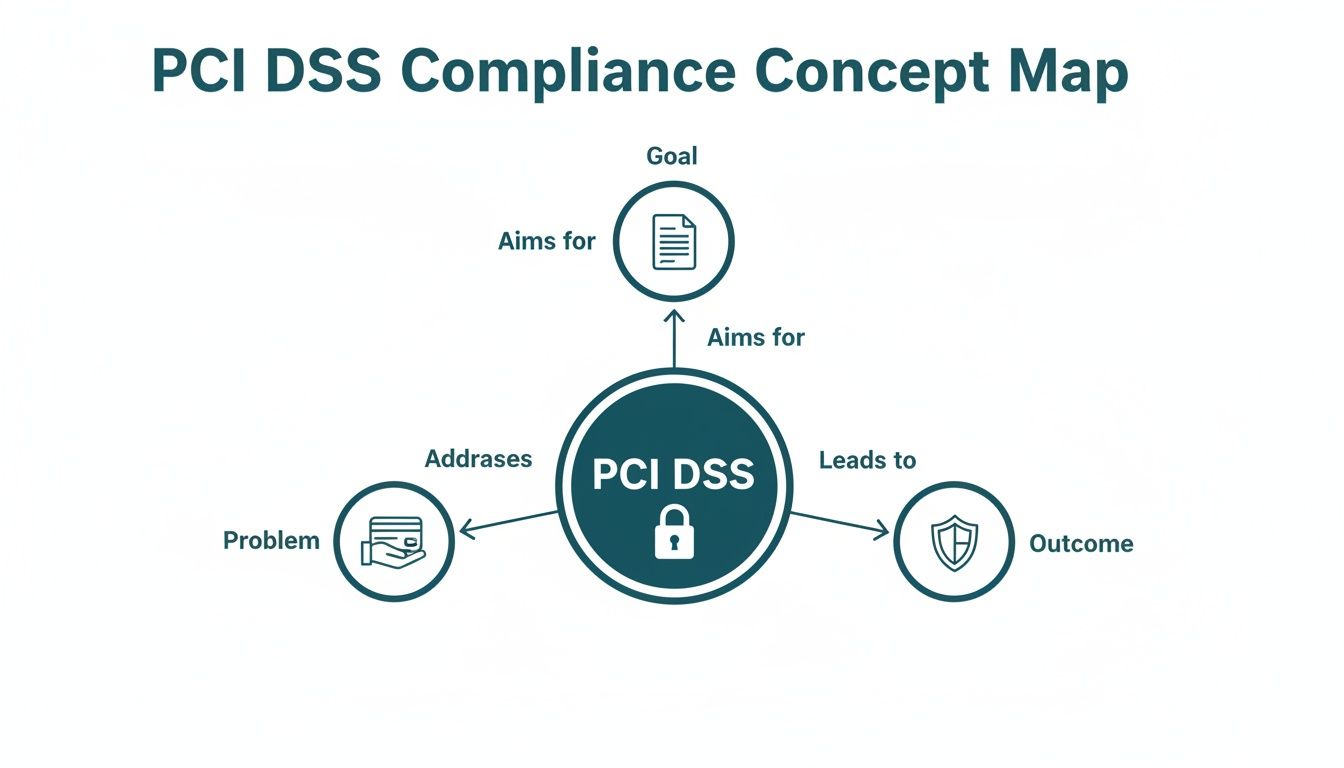
As the map shows, the whole point of PCI DSS is to solve insecure data handling, which ultimately leads to a protected, trusted payment environment.
End-to-End Encryption: The Locked Message Box
While data is moving from your customer to the payment gateway, it's at its most vulnerable. Cybercriminals are always looking for ways to intercept data in transit. End-to-End Encryption (E2EE) is the technology that slams that door shut.
It works a bit like sending a secret message in a locked box where only the intended recipient has the key. When a customer enters their payment information, it's instantly scrambled into an unreadable code (encrypted). It stays scrambled throughout its entire journey until it reaches the secure payment gateway—the only place it can be unscrambled (decrypted).
This ensures that even if a fraudster manages to intercept the data packet, all they get is gobbledygook.
Channel Separation: The Secure Payment Line
Finally, channel separation adds another powerful layer of security, especially for payments taken over the phone. Think of it as having two separate, secure phone lines running during a single call.
One line—the voice channel—is for the conversation between your agent and the customer. A second, completely separate data channel is opened just for the payment. The customer's keypad entries travel down this secure payment-only line, directly to the payment gateway.
This method guarantees the payment data never mixes with the voice channel, keeping it out of your agent's ears and, crucially, away from your call recording systems.
To help you see how these technologies fit together, here’s a quick comparison of their roles in a contact centre environment.
Comparing CNP Security Technologies
| Technology | Primary Function | Key Benefit for Contact Centres |
|---|---|---|
| DTMF Suppression | Masks keypad tones during a phone payment. | Prevents sensitive card data from being captured in call recordings, ensuring PCI DSS compliance. |
| Tokenization | Replaces real card data with a unique, non-sensitive token for storage. | Drastically reduces the scope and risk of a data breach by removing stored cardholder data. |
| End-to-End Encryption | Scrambles card data during transit to the payment gateway. | Protects data from being intercepted and read by criminals while it's travelling across networks. |
| Channel Separation | Isolates the payment data path from the voice conversation path. | Ensures payment details never enter the contact centre environment, keeping them off agent desktops and recordings. |
By integrating with payment platforms like Stripe that support these methods, you can build a formidable, multi-layered defence that secures every step of the payment journey.
Building Your Secure CNP Payment Strategy
Knowing the risks of card-not-present transactions is one thing; actively defending against them is another. This requires a proper plan. A solid strategy isn't just about bolting on new tech. It’s about weaving security into your people, processes, and the platforms you already use to create a seamless line of defence.
Think of this as a roadmap for turning theory into practice, ensuring your rollout is both smooth and effective.
The first step, always, is a bit of honest self-assessment. Where are the cracks in your armour? A thorough audit helps you map out every single point where cardholder data enters or moves through your business. This means looking at agent desktops, call recordings, CRM systems, and even those shared spreadsheets or documents that fly under the radar. Identifying these touchpoints shows you the true size of your current PCI DSS scope and flags the areas needing urgent attention.
Choosing and Integrating the Right Platform
Once you know your weak spots, you can pick a solution that actually fixes them. A secure payment platform shouldn't force you to rip out everything and start over. The smart move is to find a solution that’s built to integrate.
The best platforms play nicely with the systems you rely on every day, including:
- Telephony Systems: The solution has to work with your current Private Branch Exchange (PBX) or Voice over IP (VoIP) setup, whether it’s in the server room or in the cloud. This is non-negotiable for routing calls correctly without messing up agent workflows.
- CRM and Business Applications: Look for platforms that can plug into your Customer Relationship Management (CRM) software. This gives you automated record-keeping and a single view of the customer’s journey, linking payment status to their account without you ever having to store sensitive data.
- Payment Gateways: Make sure the platform supports the payment gateway you already use. Flexibility here is crucial—it saves you from having to tear up existing financial relationships and processes.
This integration-first mindset minimises disruption, keeps implementation costs down, and gets you to compliance much faster. It's all about making what you have better, not starting from scratch.
A successful security strategy is one that adapts to your business, not the other way around. The goal is to embed security so deeply into your existing workflows that it becomes an invisible, effortless part of every agent and customer interaction.
Empowering Your Team with Secure Workflows
Technology is only half the battle. Your team is on the front line, and getting them on board is absolutely critical. The switch to a new, secure workflow needs to be handled with care so it feels natural for your agents and your customers.
Good training isn't just about 'how' to use the new system, but 'why'. Explain that it's there to protect them from the stress and personal risk of handling sensitive data. Reassure them that their core job—helping customers—isn’t changing one bit. All you’re doing is taking the high-stakes payment part off their plate.
A well-designed workflow for a phone payment should be beautifully simple:
- The agent and customer have a normal conversation.
- When it’s time to pay, the agent initiates the secure process with a single click.
- The customer taps in their card details on their phone keypad, while DTMF suppression technology masks the tones so they can’t be heard or recorded.
- The agent watches the progress on their screen (e.g., “Card number entered,” “Expiry date entered”) but never sees or hears the actual numbers.
- Once the payment is approved, the call continues without missing a beat.
This process removes the human element as a weak link, keeps toxic data completely out of your environment, and frees up your agents to focus on what they do best: delivering great service.
Ultimately, building a secure CNP payment strategy is about creating a unified, omnichannel defence. Whether a customer pays over the phone, through a secure link sent by SMS, or in a web chat, the security controls should be consistent. This gives you a single, manageable, and compliant system that protects every transaction, every single time.
Common Questions About Securing CNP Transactions
Even with a solid plan, a few questions always pop up when it’s time to secure your card-not-present transactions. We get it. This section answers the most common queries we hear from businesses, cutting through the jargon to give you straight, practical answers.
Think of this as a final check-in to clear up any lingering doubts. By tackling these common concerns head-on, you can move forward with total confidence, knowing you’re ready to protect your customers and your business.
What Is the Single Most Effective Way to Reduce PCI DSS Scope for Phone Payments?
Easy. The best way is to make sure sensitive card details—like the full card number (PAN) and security code (CVC)—never enter your business environment in the first place. That’s the golden rule of scope reduction.
Technologies like DTMF suppression were built for exactly this. When a customer taps their card numbers into their phone keypad, this technology intercepts and masks the tones. The actual payment data is routed directly to the payment gateway, completely bypassing your systems.
It's a simple idea with a massive impact. The data never touches your agents, their computers, your network, or—crucially—your call recordings. By taking all those elements 'out of scope', you drastically shrink your PCI DSS burden, cut audit costs, and practically eliminate the risk of an internal data breach.
How Does Tokenization Protect Customer Data for Recurring Payments?
Tokenization is like having a digital stand-in for your customers' card details. It’s a way to handle recurring payments without ever storing the sensitive information yourself. It works by swapping out real card details for a unique, non-sensitive placeholder called a 'token'.
Here’s how it works for a subscription or payment plan:
- First Payment: The customer gives you their real card details for the initial transaction, which are sent securely to your payment gateway.
- Token Generation: After processing the payment, the gateway creates a unique token and sends it back to you. This token has no mathematical link to the original card number.
- Secure Storage: You save this harmless token in the customer's account instead of their actual card info.
- Future Payments: For every payment after that, you just send the token to the gateway. That's it.
If a criminal ever breached your systems, all they’d find is a list of useless tokens. They wouldn’t get any valuable card numbers to exploit. This makes tokenization an absolute must for any business managing repeat payments, as it cuts the cord between your systems and the raw card data.
Can We Still Record Calls for Training Without Violating PCI DSS?
Absolutely. This is a non-negotiable for most contact centres, and it’s a problem that modern payment platforms are designed to solve. You don’t have to sacrifice quality assurance for compliance.
The trick is to use technology that isolates the payment part of the conversation. With DTMF masking or a secure IVR, the moment a customer enters their card details is handled in a separate, secure bubble.
The sensitive keypad tones are either silenced or rerouted, so your recording software never even captures them. This means you can keep recording 100% of the customer service interaction for training, quality checks, and dispute resolution. The payment data stays completely separate and unrecorded, keeping your recordings fully compliant with PCI DSS.
Do We Need Separate Security Solutions for Phone, Web Chat, and Payment Links?
You could, but you really shouldn't. Juggling different systems for each channel is a recipe for security gaps, messy reporting, and a disjointed customer experience. It’s far better—and safer—to use a single, unified platform.
The best secure payment platforms are built to be omnichannel. They give you one central solution to handle payments securely, no matter where they come from:
- Agent-assisted phone calls
- Secure payment links sent by SMS or email
- Web chat and chatbot conversations
- Automated IVR systems
An integrated approach puts all your security controls and compliance management under one roof. It simplifies life for your team, creates a smooth and trustworthy journey for your customers, and guarantees every single card-not-present transaction is protected with the same high standard of security.
At Paytia, we provide a unified platform to secure every payment channel, from phone calls to web chat. Our solutions use DTMF suppression, tokenization, and end-to-end encryption to keep your business out of PCI DSS scope while delivering a seamless experience for your customers and agents. Discover how you can simplify compliance and eliminate fraud risk by visiting https://www.paytia.com.
Ready to Get Started?
Contact Paytia to learn how we can help secure your payment processing.