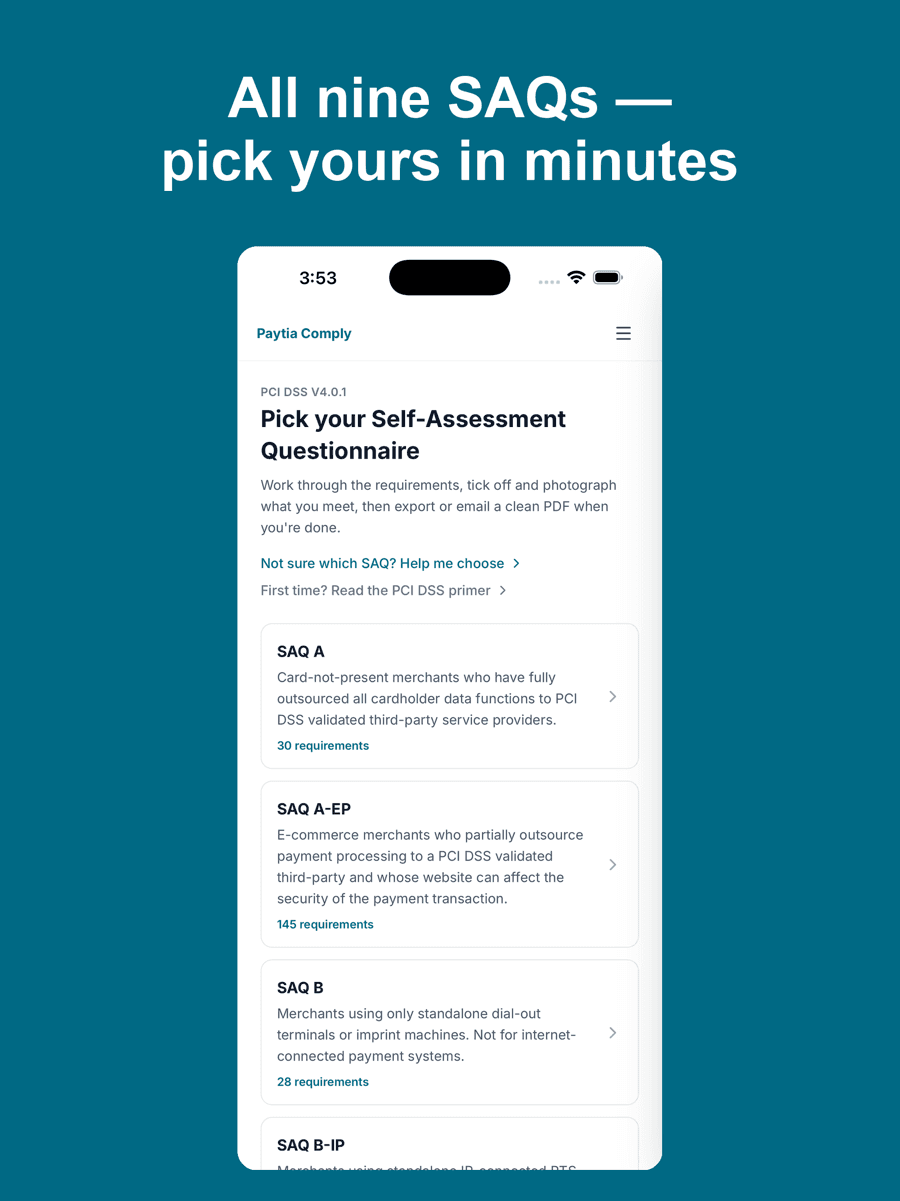

US reader? See the US version of this guide with US-specific compliance detail (TCPA, NYDFS, CCPA, FedNow, US PCI scope guidance).
If you take card payments, you've heard of PCI DSS. Here's what it actually is.
The Payment Card Industry Data Security Standard (PCI DSS) is the rulebook for any business that accepts, processes, or even touches customer card details. It's not a government law — it's a set of mandatory security standards from the major card brands (Visa, Mastercard, American Express, Discover, JCB) to cut card fraud and stop data theft.
The Essential Rulebook for Payment Security#

PCI DSS applies to every UK business that stores, processes, or transmits cardholder information. A small shop taking a few payments a day, a multinational handling millions — if you touch card data, you comply. For contact centres taking payments over the phone, this matters more than most because agents and recording systems are constantly handling sensitive information.
Who Created and Enforces PCI DSS?
The PCI Security Standards Council (PCI SSC) wrote the standard. It's an independent body formed by American Express, Discover, JCB International, Mastercard, and Visa. But the council itself doesn't enforce compliance — that's a common misconception.
Your acquiring bank enforces it. The bank that processes card payments on your behalf holds you to the standard through your contract. Fail to meet it and your acquirer is the one issuing the fines, or in the worst case, pulling your ability to accept card payments at all.
The point of PCI DSS is simple: create a secure environment for cardholder data. It sets out the technical and operational requirements to protect that data at every point in the payment process.
Getting PCI DSS right is how you protect customers, your reputation, and the business itself. For contact centres, it isn't box-ticking — it's how you build and keep customer trust.
Understanding the Four PCI DSS Merchant Levels#
Compliance starts with a simple question: where does your business sit? The answer is your merchant level, based on how many card payments you process each year.
This isn't about penalising larger businesses. It matches the level of validation to the level of risk. A multinational retailer handling millions of payments is a much bigger target than a local bakery, so the scrutiny is heavier.
Your level dictates how you prove compliance — anything from a self-check to a full independent on-site audit.
Level 1 Merchants: The Highest Scrutiny
The top tier, reserved for the largest enterprises. In the UK, you're Level 1 if you process over six million card transactions a year across all channels — in-store, online, phone. A merchant of any size that's suffered a data breach can also be pushed into Level 1.
Level 1 validation is the most demanding:
- Annual Report on Compliance (ROC) — a full on-site audit by an independent Qualified Security Assessor (QSA), checking every aspect of the business against the 12 PCI DSS requirements.
- Quarterly Network Scans — performed by an Approved Scanning Vendor (ASV), probing your external networks for vulnerabilities.
- Attestation of Compliance (AOC) — the formal sign-off, signed by the business and the QSA.
Levels 2, 3, and 4: The Self-Assessment Path
For most businesses below the six-million threshold, the process is lighter. The security rules still apply to everyone — what changes is how you prove compliance. Instead of a QSA audit, you can usually manage it yourself through self-assessment.
PCI DSS Merchant Levels at a Glance (UK)
| Merchant Level | Annual Transaction Volume | Typical Validation Requirement |
|---|---|---|
| Level 1 | Over 6 million transactions | Annual Report on Compliance (ROC) by a QSA |
| Level 2 | 1 to 6 million transactions | Self-Assessment Questionnaire (SAQ) and Attestation of Compliance (AOC) |
| Level 3 | 20,000 to 1 million e-commerce transactions | Self-Assessment Questionnaire (SAQ) and Attestation of Compliance (AOC) |
| Level 4 | Under 20,000 e-commerce transactions | Self-Assessment Questionnaire (SAQ) and Attestation of Compliance (AOC) |
Note: These are general guidelines. Your acquiring bank has the final say on your specific requirements.
Each level maps to a different version of the Self-Assessment Questionnaire (SAQ). The SAQ you complete depends on your level and how you take payments — online, in-person, over the phone, or a mix.
Your merchant level isn't a badge — it's a risk indicator. The higher your level, the more rigorously you have to prove your defences are sound.
Choosing the wrong SAQ wastes time, and worse, can leave you non-compliant without realising it. Our guide breaks down the levels of PCI compliance and their requirements in detail.
Want to see this working in your setup? Book a working-demo call — we'll wire up your actual phone system and show you a live capture.
Decoding the 12 Core PCI DSS Requirements#
The heart of PCI DSS is 12 core requirements. They aren't arbitrary — they're a logical framework for protecting cardholder data at every step. For a busy contact centre, 12 sounds daunting, but each one rests on a common-sense security principle.
We've grouped them into six security goals, each supported by two requirements. Thinking about the goals first makes the rules easier to apply day to day.
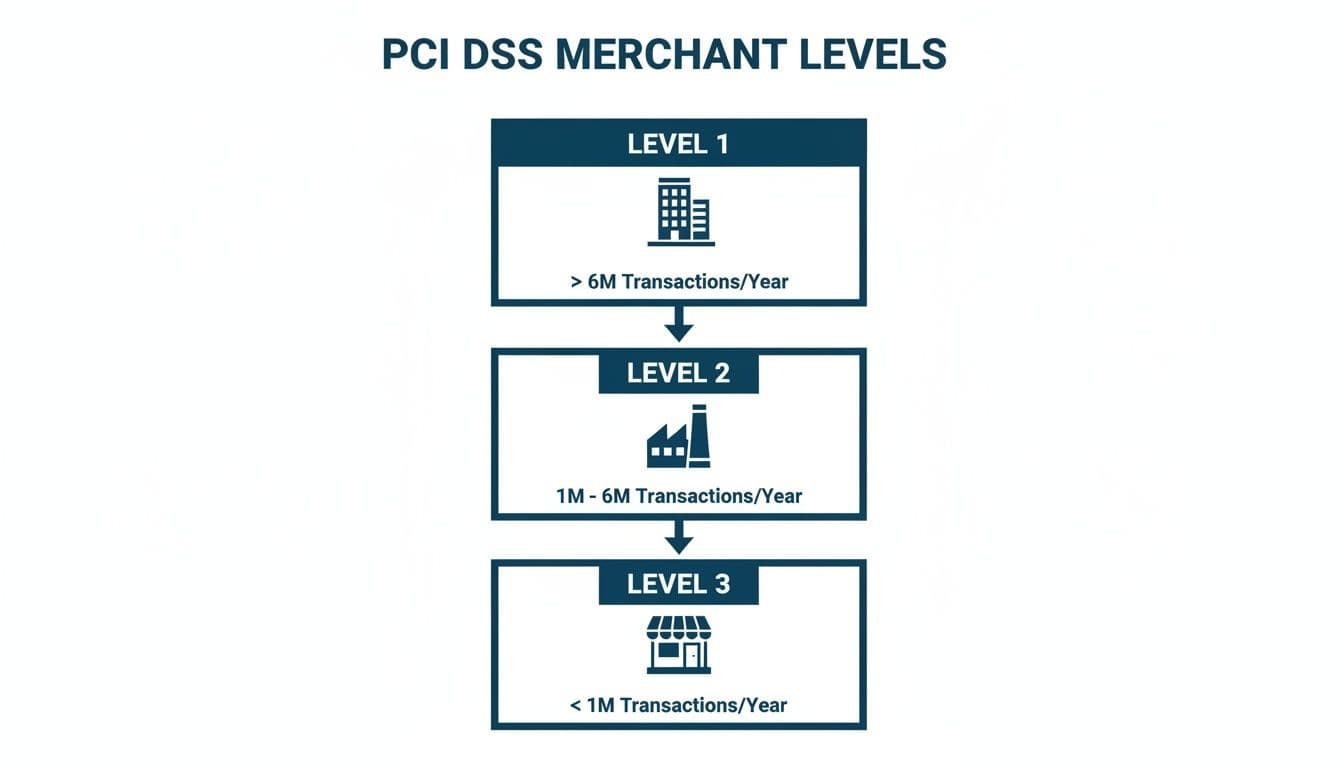
The image below shows how merchants are classified by transaction volume — the level that dictates how rigorously you have to prove these 12 requirements are met.
 6M), Level 2 (1-6M), Level 3 (<1M) transactions yearly.">
The more you process, the heavier the scrutiny — from a straightforward self-assessment for smaller businesses to an on-site audit for the largest.
Goal 1: Build and Maintain a Secure Network
You need strong digital walls around your systems. The front-door analogy is obvious but it's the first line of defence.
Requirement 1: Install and Maintain Network Security Controls. Firewalls. In a contact centre, a well-configured firewall sits between the outside world and your phone systems, CRM, and payment applications, blocking everything that isn't trusted.
Requirement 2: Apply Secure Configurations to All System Components. Default passwords and out-of-the-box settings are how breaches start. Change every vendor default, strip out unnecessary software and services, and shrink the attack surface.
Goal 2: Protect Account Data
Once the perimeter's secure, protect the data itself — whether it's sitting on a server or moving between systems.
Requirement 3: Protect Stored Account Data. The golden rule: if you don't need it, don't store it. If you must hold card data, it has to be unreadable — encryption, truncation, or tokenisation. For call recordings, the safer move is making sure card details are never captured in the first place.
Requirement 4: Protect Cardholder Data with Strong Cryptography During Transmission. Open networks like the internet leak. Use strong encryption (TLS) for any payment details sent via email links, web chat, or other digital channels.
Key Takeaway — The first four requirements are about making stolen data useless. Strong encryption and secure network configuration are non-negotiable.
Goal 3: Maintain a Vulnerability Management Programme
Security isn't a one-off. Threats change, software changes, and you need a programme to find and fix weaknesses before someone else does.
Requirement 5: Protect All Systems and Networks from Malicious Software. Anti-malware on every system that could be affected, kept up to date. Your defence against known threats.
Requirement 6: Develop and Maintain Secure Systems and Applications. Patch promptly. Whether it's your own code or a vendor's, apply security updates as they ship to close newly discovered vulnerabilities.
Goal 4: Implement Strong Access Control Measures
Not everyone needs access to sensitive data. This goal is the principle of least privilege — people get access only to what they need for their role.
Requirement 7: Restrict Access to Cardholder Data by Business Need to Know. In a contact centre, that means agents don't see full card numbers unless their specific job demands it.
Requirement 8: Identify and Authenticate Access to System Components. Every login needs a unique ID. Shared accounts are out. Multi-factor authentication is in — proving the user is who they say they are.
Goal 5: Regularly Monitor and Test Networks
You can't protect what you can't see. Monitor everything, and stress-test the defences regularly.
Requirement 9: Restrict Physical Access to Cardholder Data. Not just digital — physical servers, paper records, payment terminals. Locked rooms, secure cabinets, logged access.
Requirement 10: Log and Monitor All Access to System Components and Cardholder Data. A digital paper trail. Track every access to network resources or card data, so suspicious activity gets spotted early.
Goal 6: Maintain an Information Security Policy
Good security culture is built on clear rules. This last goal formalises everything — written policies, clear responsibilities, training, and incident response.
Requirement 11: Test Security of Systems and Networks Regularly. Regular vulnerability scans and penetration tests find security holes before attackers do.
Requirement 12: Support Information Security with Organisational Policies and Programs. A formal written security policy covering staff training, incident response, and third-party service provider management.
For more detail, see our full PCI DSS requirements checklist.
How to Drastically Reduce Your PCI Compliance Scope#
Your PCI scope covers every person, process, and piece of technology in your business that stores, processes, or transmits cardholder data. The bigger the scope, the more systems you have to protect, document, and audit — and the bigger the target for criminals.
Reducing scope is the single highest-use move in PCI DSS compliance. The trick is to stop sensitive cardholder data — the full PAN and the CVC — from ever entering your environment. If the data isn't there, you don't have to protect it under PCI DSS rules.
The Power of Removing Data from Your Environment
For contact centres this is the difference between a manageable audit and a massive one. The traditional model — agents hearing card numbers over the phone — pulls the entire telephony stack, call recording, and agent workstations into scope. That's where the compliance pain lives.
Modern technology intercepts payment details before they reach your business, creating a barrier between your environment and the sensitive data.
Two Technologies That Do the Heavy Lifting
Two proven approaches let you process payments without your contact centre ever touching raw card details:
- DTMF Masking — When a customer pays over the phone they enter their card details on their keypad. DTMF masking intercepts the tones, so they're never heard by the agent or captured by call recording. The agent stays on the line to guide the customer; the data bypasses your network completely.
- Secure Digital Payment Links — Instead of asking for card details verbally, agents send a one-time secure payment link via SMS, email, or web chat. The customer pays on their own device through a secure page. Nothing is spoken, seen, or stored by your business.
Adopt these methods and you de-scope your agents, phone systems, and call recordings in one move. That doesn't just simplify audits — it removes the main way card data gets stolen in a contact centre.
Staying compliant is still a serious challenge. Global studies put the share of organisations that fully maintain compliance year on year at about 32%, and the recent PCI DSS adoption and enforcement study spells out where most are slipping. Platforms that actively reduce scope take entire departments and systems out of audit reach, and that is what makes compliance simpler, cheaper and more likely to hold.
Where We Are with PCI DSS 4.0.1 (May 2026)#
PCI DSS v4.0.1 is the current version of the standard. v4.0 was the biggest update to PCI DSS in years, published in early 2022, and it replaced v3.2.1 entirely. The transition is done — v3.2.1 was retired and the future-dated v4.0 requirements became mandatory on 31 March 2025. v4.0.1, released in mid-2024, is a clarification release that's now the version your QSA or acquirer expects you to be aligned with.
If you're still operating to a v3.2.1 mindset, you're behind. Here's what's actually in force right now.
From Prescriptive Rules to Objective-Based Security
v4.0 moved the standard away from the rigid tick-box mentality. In its place is a more flexible, goal-oriented framework. You can implement controls that fit your specific tech stack, as long as you can prove they meet the standard's security objectives. The shift is from prescriptive rules to objective-based security.
That reflects how payments actually work now — cloud services, diverse channels, no one-size-fits-all. It also raises the bar on risk analysis, because you have to justify the security measures you've chosen.
The Customised Approach
One of the headline v4 changes is the Customised Approach. It lets you meet a requirement's objective using a different method than the one spelled out. You're given the destination and choose your own route.
To use it you have to:
- Conduct a targeted risk analysis for each control you customise.
- Document everything in detail to show your solution meets the original objective.
- Test and validate that the custom control works in practice.
Useful for businesses on modern cloud setups, but it demands a mature understanding of risk. For most, the traditional defined approach is still simpler.
What Became Mandatory on 31 March 2025
v4.0 introduced 64 new requirements. 51 of them became mandatory on 31 March 2025 — they're no longer "future-dated" or "best practice." If you're being assessed today, you're being assessed against them.
For a full breakdown of what changed and how it affects phone payments, see our PCI DSS v4.0.1 contact centre guide.
The Biggest Practical Changes for UK Contact Centres
The table below summarises the v4 changes that hit UK contact centres hardest. Treat this as historical context for how the standard evolved — every row below is mandatory now.
| Requirement Area | What v4 Changed | Impact on UK Contact Centres |
|---|---|---|
| Authentication | Multi-factor authentication required for all access into the cardholder data environment, not just administrators. | Every user — agents, team leaders, managers — needs MFA to access payment systems or CRMs handling card data. |
| E-commerce Security | New requirements to manage payment page scripts and protect against client-side attacks like e-skimming. | If you use web chat or payment links, you need controls to detect and prevent unauthorised scripts running on payment pages. |
| Risk Analysis | Greater emphasis on targeted risk analyses to set the frequency of certain security activities. | You have to formally document why security tasks (e.g. log reviews) are performed at their chosen frequency. |
v4.0.1 isn't a refresh — it's a strategic realignment. The standard expects a proactive, risk-aware security posture, not a passive checklist.
The most effective way to meet the new bar is to adopt scope-reducing payment tech. Take a platform like Paytia that de-scopes your contact centre from ever handling card data directly, and the stricter authentication, e-commerce, and risk-analysis requirements get a lot easier — because they apply to a much smaller environment. For the full picture on setting up a PCI compliant call centre, see our dedicated guide.
What Non-Compliance Costs#
PCI DSS isn't law, but the consequences of ignoring it are real, and they arrive through your acquirer. Lapse on your annual validation and most acquirers add a monthly non-compliance fee to your merchant statement. Suffer a breach and the bill grows fast: card scheme assessments passed down the contract chain, a mandatory forensic investigation, card reissue costs, higher processing rates afterwards and, in the worst case, a terminated merchant account. In the UK the ICO sits alongside all of that, because card data is personal data and a breach can bring an investigation under UK GDPR on top.
We've covered who enforces PCI DSS in the UK, what your acquirer asks for and what lapsing actually costs in our guide to PCI compliance in the UK. The short version: the monthly fee is the cheap part.
Making PCI DSS Compliance Easier#

If you remember one thing from this guide: the fastest route to easier PCI DSS compliance is shrinking your scope. The less of your business that touches cardholder data, the smaller your audit, the lower your costs, and the lower your breach risk.
That's what we built Paytia to do. DTMF masking keeps card numbers out of your agents' ears and your call recordings. Secure payment links keep card details on the customer's own device. Either way, your contact centre stops being part of the cardholder data environment — which is where the bulk of audit pain comes from.
If you want a practical starting point, our PCI DSS compliance checklist walks through the steps.
Ready to take the complexity out of PCI DSS compliance? Paytia's secure payment platform — see the PCI DSS v4 solution — removes sensitive card data from your contact centre, cutting scope by up to 95%. Lower costs, simpler audits, more customer trust at Paytia.
Related reading#
- Pillar guide: PCI DSS v4.0.1 contact centre guide
- PCI DSS 4.0 Phone Payments: 2026 Compliance Checklist
- HIPAA vs PCI DSS: What Healthcare Providers Need to Know
- What Is AOC? Attestation of Compliance Explained
- PCI Scope Reduction (Descoping): Cut Audit Scope 96%
Want to see this working in your setup? Book a working-demo call — we'll wire up your actual phone system and show you a live capture.